
dsh-better-reasoning-effort
Models & DataHaoyueQin/dsh-better-reasoning-effort
Enables reasoning-effort and input-modality editing for third-party models in DeepSeek Harness, with per-model thinking levels and auto-adaptation from a knowledge base.
- automation
- deepseek
- deepseek-harness
- dsh-plugin
- llm
- plugin
- react
- reasoning
- reasoning-effort
- settings
- typescript
- web
README
DSH Better Reasoning Effort








English | 中文
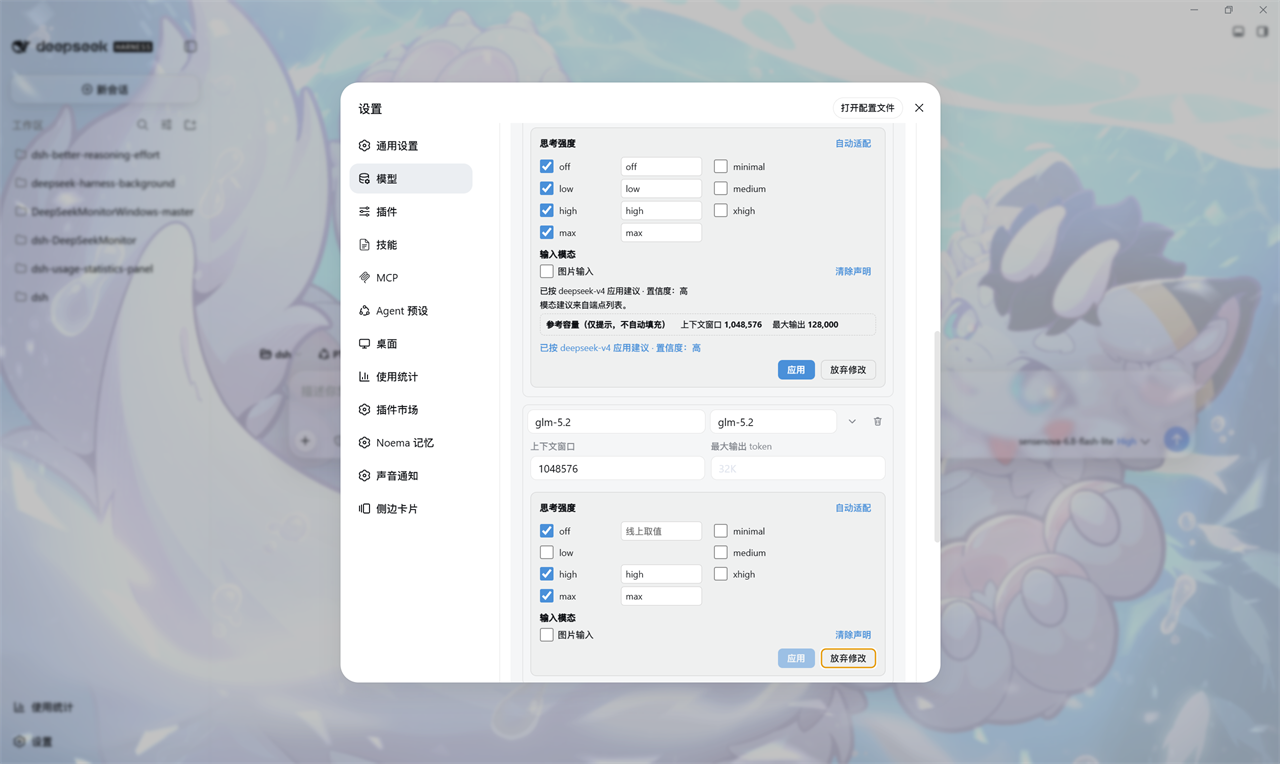
Reasoning-effort and input-modality editing for third-party models in DeepSeek Harness — thinking levels and image-input support declared per model, auto-adapted from a model knowledge base + wire-protocol inference, edited right inside the official Models page card.
Why
The llm-pi-ai adapter of DeepSeek Harness natively supports per-model reasoningEfforts declarations (which thinking levels a model accepts, and the exact string to send on the wire for each). But the official Models page editor deliberately keeps this field out of reach — the official notes say it is a per-model capability and a provider-level knob would break some models. As a result:
- Third-party models get no thinking-level picker in the composer (
getSupportedThinkingLevelsshort-circuits to["off"]); - Only the official DeepSeek API (the built-in catalog) can set reasoning effort;
- Setting levels for a third-party model meant hand-writing the
reasoningEfforts/compatblocks insettings.yaml. - Hand-declared third-party models are treated as text-only (
inputdefaults to["text"]): image attachments are refused before they are sent, the read-image tool refuses, and every gateway path in between gates on the same flag. The core already accepts a per-modelinput: ["text", "image"]declaration — the official page just does not expose it either.
This plugin brings both configuration surfaces back into the UI: edit right inside the official model editor card, plus one-click auto-adapt.
Features
- In-page injection: an editor block appears in the official Models page under each model row's disclosure, next to context window / max tokens — not a separate settings page, but part of the official editing flow (same
settings.mutatecontract, same save style). The block spans the full row; its level rows split into the same two columns as the official capacity pair. It now carries two sections — Reasoning effort and Input modalities — owned by one pair of Apply/Reset buttons at the bottom. - Create-card staging: the editor also appears while a provider is still being created — auto-adapt works from the typed protocol/endpoint, Stage holds the declaration, and the plugin writes it automatically the moment the provider is saved (a declaration already in the document is never overwritten).
- Input-modality declaration: one checkbox ("Image input") turns a hand-declared model vision-capable end to end — composer attachments, the read-image tool, and proxy gating all key off the same flag. Unchecking narrows the declaration to text-only; clearing it writes a durable
inputUnsetmarker that host auto-fill respects, exactly like its reasoning-efforts sibling. - Zoned suggestion display: Auto-adapt reports what it applied (source · confidence) on its own line, says where modality advice came from (endpoint listing / knowledge base / name heuristic — the last one explicitly flagged low-confidence), and renders reference capacities (context window, max output) in a separate read-only block marked "hints only, never auto-filled". Values are thousands-grouped so you can copy them straight into the official capacity inputs by hand.
- Auto-adapt: a built-in model knowledge base (DeepSeek V3/V4/R1 with its vision experiment; OpenAI GPT-4o/GPT-4.1/GPT-5.1–5.6 by generation including the codex variants, the o-series, the gpt-oss open weights and the non-reasoning
-chatlines; Claude 3.x/4.5–5 with per-generation effort ladders (only the models Anthropic officially lists as effort-capable get one), Gemini, Grok 4.3–4.6, Mistral Small 2603 / Medium 3-5 (the reasoning_effort models; the deprecated magistral line declares no effort control), Qwen incl. Qwen-VL/QvQ and the 3.8 generation, GLM incl. GLM-4V/4.5V/4.6V/5V and GLM-5.2/5.3, Kimi K2.5/K2.6/K2.7-Code/K3, MiniMax M3's thinking toggle, Doubao, Hunyuan hy3, Step incl. 3.5/3.6/3.7, Baidu ERNIE (no effort control on the official surface) — every entry re-verified against each vendor's official docs in 2026-08 and cross-checked against the public OpenRouter catalog; vision-capable variants carry their own entries so the base stem never claims images for them) plus protocol inference keyed by pi-ai's real wire protocols (openai-completions/openai-responses/anthropic-messages, plus a DeepSeek endpoint dialect frombaseURL— onlyapi.deepseek.com, the verified official host) fills recommended levels and wire spellings in one click. Families whose endpoints expose no effort-style control reachable here (Llama, Nova, Phi, Cohere, Perplexity sonar) deliberately carry no entry — the low-confidence generic suggestion is more honest. Compat suggestions are gated per protocol: the openai-completions gate takes thinkingFormat/supportsReasoningEffort, and adaptive-thinking Claude families on anthropic-messages routes get theforceAdaptiveThinkingpin that makes pi-ai dispatch their declared efforts asoutput_config.effort. - Endpoint evidence: Auto-adapt also probes the provider's RAW
/modelslisting through a same-origin host route (credential resolved server-side, never echoed) and fuses the signal by confidence — an explicit "does not reason" wins outright; knowledge-base wire values stay authoritative; every suggestion is labeled high / medium / low so you know what to double-check. The same probe reads modality disclosures (OpenRouter-stylearchitecture.input_modalities, models.dev-style nesting,supported_features/capabilitiesvision flags,supports_vision) and the advertised context length; an explicit listing outranks the knowledge base, silence changes nothing. - Host auto-fill: on every settings update, models without a
reasoningEffortsdeclaration get a recommended one — and missing input-modality declarations are filled too (opt out viamodalityAutofill: false; declared parts, explicitfalse, and deliberately unset markers are never touched, and capacities are never written at all). The write is optimistic-locked: if your edit moved the namespace first, the fill backs off and waits for the next update — it never fights you for the write. - Three intents: all levels off = unset the declaration (back to inheritance — persisted as a
reasoningEffortsUnsetmarker so auto-fill respects it, even across restarts); onlyoffarmed = disable reasoning (false); levels armed = write the declaration. The editor stays in sync with official-page re-renders and pushed settings changes without clobbering your in-flight edits. - Defensive injection: the injector keys off the official page's DOM (aria-labels / classes). If an official upgrade changes the structure, injection simply stops and the official page is untouched; the next scan re-injects once the structure is back.
- Bilingual copy (中文 / English).
Install
Requires DeepSeek Harness 0.1.1-rc.1 or newer (@deepseek-ai/dsh-api-remotes@^0.1.1-rc.1; the host half also peers on @deepseek-ai/dsh-settings@^0.1.1-rc.1 and @deepseek-ai/schemastery@^3.18.0). The wire contract is verified against 0.1.1-rc.2; older release-candidate lines are not supported.
From npm
# under the dsh web profile
dsh plugin --profile web add dsh-better-reasoning-effort
From GitHub
# under the dsh web profile
dsh plugin --profile web add github:HaoyueQin/dsh-better-reasoning-effort
The github: source only pulls source; lib/ is built by the package's prepare hook. pnpm does not run build scripts of git dependencies by default — the installer prints the allowBuilds key it needs; follow that and add again.
Local development
npm install && npm run build
dsh plugin --profile web add link:D:/Project/dsh-better-reasoning-effort
Restart dsh web, hard-refresh the browser. Each model row's disclosure on the official Models page now carries a "Reasoning effort" block.
Usage
- Configure a third-party provider (API key etc.) on the official Models page.
- Expand a model row: the editor block sits under the official capacity fields.
- Check levels (off / minimal / low / medium / high / xhigh / max) and fill the wire values (e.g. give
highthe spellingultra, and the gateway receivesultrawhen you pick High in the composer); - Toggle Image input under Input modalities to declare what the model accepts (unchecked with no declaration = inherit the provider default, usually text-only);
- Click Auto-adapt to fill recommended levels and modalities from the knowledge base / protocol / endpoint listing — reference capacities show up as read-only hints you can copy into the official fields yourself;
- Click Apply to write the setting.
- Check levels (off / minimal / low / medium / high / xhigh / max) and fill the wire values (e.g. give
- All levels off + Apply = unset the declaration; only
offchecked + Apply = disable reasoning (false); Clear declaration on the modality row + Apply = back to inheriting the provider default.
Declared models are immediately selectable for reasoning effort in the composer's model picker, and image-declared models accept attachments end to end.
Configuration
The host half accepts optional configuration on its profile row (the values below are the defaults):
- insert:
    - id: dsh-better-reasoning-effort
      name: dsh-better-reasoning-effort
      config:
        # Auto-fill undeclared models on boot and after settings updates.
        autofill: true
        # Whether the auto-fill above also fills input-modality declarations.
        modalityAutofill: true
        # Upstream /models probe fetch timeout, in milliseconds.
        probeTimeoutMs: 15000
        # Boot-fill retry backoff schedule; [] means "try exactly once".
        bootRetryDelaysMs: [1000, 2000, 4000, 8000, 16000, 30000]
Set autofill: false to disable the silent auto-fill entirely — the browser-side Auto-adapt button keeps working.
How it works
Browser (lib/client.js)                  Host (lib/index.js)
├─ DOM injector                          └─ Auto-fill
│   MutationObserver on the models page      settings/updated → adds a
│   → mounts EffortEditor in each            recommended reasoningEfforts
│     model row's disclosure                 for undeclared models
├─ EffortEditor (React component)             (knowledge base + inference)
│   level checkboxes / wire values /
│   input-modality toggle /
│   auto-adapt (zoned suggestions) / apply
│   └─ writes settings.mutate (llm-pi-ai)
- Knowledge base + protocol inference:
suggestEfforts()insrc/knowledge.ts, a pure function shared by host and browser — fusing endpoint signals, curated entries (levels, modalities, reference capacities), a name heuristic, and protocol inference. - DOM injection:
reconcile()insrc/client/injector.tslocates model rows by the official button aria-label (Capacities/容量) and mounts the editor into the capacity disclosure. - Writing:
createEditorApi()insrc/client/ops.tsrewritesproviders.<route>.models[i].reasoningEfforts— and, when an intent travels,.input— viasettings.mutate, preserving every other row field; on a revision conflict it re-reads and retries once (the same recovery the official settings form uses). - Shared constants:
src/constants.tscarries the plugin id, settings namespace, and DOM marker used by both halves.
Development
npm run typecheck   # tsc strict check on src
npm test            # vitest: knowledge / inference / autofill / DOM injection / writing
npm run build       # lib/*.js + lib/client.js (module-loader bundle)
Contract version: @deepseek-ai/dsh-api-remotes@0.1.1-rc.2 (client contract types), verified by typecheck, the test suite, and a full build against the 0.1.1-rc.2 packages.
Known limitations
- Injection depends on the official Models page's current DOM (aria-label/class). If an official upgrade changes the structure, injection pauses until adapted; the official page is unaffected meanwhile.
- The auto-adapt probe route answers loopback and IP-literal Hosts only — the core
/apifence's Host-allowlist discipline without itstrustedHostsescape hatch (a rebound page always names the attacker's domain in Host, so named hosts are refused outright). LAN deployments serving the GUI under a domain name get a 403 from this one route (IP-literal LAN hosts keep working); every other feature is unaffected. reasoningEffortsdeclarations are suggestions: which levels/spellings an endpoint actually accepts is up to its docs — tweak each in the UI.- The knowledge base is not exhaustive — spellings drift as vendors ship models, and families without an effort ladder carry no entry at all; unlisted models fall back to protocol inference + generic levels and can be adjusted by hand.
- The modality vocabulary follows pi-ai's core (
text/imagetoday). Wider support some gateways serve (PDF, audio, video) is recorded per family until the core vocabulary grows — declaring them is impossible today by design, not oversight. - Name-heuristic modality advice (vision-flavored ids like
*-vl*/*vision*/gpt-4o) is deliberately low-confidence and labeled as such — verify before relying on it.
License
MIT