
dsh-composer-history
UI & ExperiencePerryLink/dsh-composer-history
Terminal-style input history for the DeepSeek Harness web composer: arrow-key recall, browser-local persistence, Ctrl+R reverse search, workspace recall, and sliding-context awareness with compaction summaries.
- compaction
- composer
- context-window
- deepseek-harness
- dsh
- dsh-plugin
- input-history
- keyboard-shortcuts
- sliding-context
- terminal
- typescript
- ui
- web-gui
Verification and compatibility
This section shows evidence collected by the catalog. Undeclared information is labeled as unknown.
- Current-version compatibility
- Verified on the catalog Harness version
- Declared Harness range
- Not declared
- Declared platforms
- Not declared
- Profiles
- web
- Build approval
- Unknown
- Permissions
- Not declared
- External services
- Not declared
- Telemetry
- Unknown
This is not a security endorsement. Review source, permissions, and configuration before installing.
View evidence and scope
Verification covers only the named source, version, and Harness environment. It does not guarantee future compatibility.
dsh-composer-history@0.5.3- The manifest and static structure passed checks; a runtime load check has not completed.
README
⌨️ dsh-composer-history
Release stamp:
0.8.8(2026-10-04).
- 1024 store channel:
npm i -g dsh1024once, thendsh1024 plugin --profile web add dsh-composer-history(counts toward the deepseek1024.com install ranking).

Terminal-style input history for the DeepSeek Harness Web GUI composer.
Press ↑ like it's in a terminal — and keep your half-typed draft safe.









English · 简体中文 · Español · Português · हिन्दी
📖 Ecosystem knowledge base — measured data, not marketing: plugin development guide · plugin-selection data · maintenance criteria.
⭐ 如果它帮到了你
这个插件是 DSH 插件家族的一员(40+ 个,全部 Apache-2.0)。如果你在用,给个 star —— 它不会解锁任何功能,但会让下一个人在搜索里更容易找到它。
English: part of a 40+ plugin family for DeepSeek Harness. If it is useful, a star helps the next person find it — nothing is gated behind it.
What is dsh-composer-history?
Terminal-style input history for the DeepSeek Harness Web GUI composer.
Press ↑ like it's in a terminal — and keep your half-typed draft safe.
Compatibility
| Surface | Status |
|---|---|
| Harness | DeepSeek Harness dsh-v0.2.1-alpha.1 (verified 2026-09-25: dual typecheck rulers + 294 tests; client peers >=0.1.2-rc.1 <0.2.0 || >=0.1.5-alpha.1 <0.2.0 || >=0.1.6-0 <0.2.0 || >=0.1.7-0 <0.2.0). On this line the settings seam is the profile entry's own live Config form — the removed ctx.settings.register / SettingsProvider family and the client ctx.settingsScope service are both gone, so every tunable now travels through ctx.configForms. On the 0.1.6+ lines SessionListState.current is gone — the current session is derived from the retention facts, so history injection / the snippet library keep working. |
| Node | ^22.19.0 || >=24.0.0 |
| Platforms | Web GUI only (client plugin; browser-local storage; no network, no native code) |
| Model | Any (no model requests — pure UI behavior) |
The browser half rides the published client packages (dsh-client-ui-conversation, dsh-client-ui-input-trigger, dsh-client-ui-settings) and the cordis Context; it no longer depends on the removed dsh-client-runtime package, so the client surface also lines up with 0.1.2-rc.1 hosts.
Interception anchors on the web composer's DOM: the contenteditable surface div[data-composer-input] inside [data-input-scroll] (the Lexical composer shipped since 0.1.2-alpha.5 / 0.1.2-rc.1), with the legacy textarea composer inside [data-input-scroll] (harness lines up to 0.1.1-rc.2) still matched; textareas elsewhere pass through. The compat workflow's jsdom web-behavior smoke asserts this identity/text/caret face against the packed bundle.
0.1.2-rc.1 (adapted 2026-09-04): the session envelope keeps its ignorable field for stored-log read compatibility only - Session.append still cannot stamp it, so audit-gate behavior is unchanged. Verified 2026-09-06 against the dsh-v0.1.7-alpha.1 master checkout (full gate chain + profile install smoke).
0.1.5-rc.1 (adapted 2026-09-10): dependency pins move to the published 0.1.5-rc.1 line; no seam change affects this plugin's behavior.
0.1.5-rc.2 (adapted 2026-09-11): dependency pins move to the published 0.1.5-rc.2 line; no seam change affects this plugin's behavior.
0.1.7-alpha.1 (adapted 2026-10-04): the settings seam is replaced on both halves. The host half no longer registers a composer-history namespace through the removed ctx.settings.register(ns, schema, { base }) — on this line a plugin's durable settings surface IS its own live Config: every tunable is declared .volatile(), the profile entry id (composer-history, the bundle patch's row id) names the form, and apply claims the generated-form presentation (ctx.settings.configure({ auto: true }, ctx.fiber), effect-owned so a reload re-registers cleanly). The browser half reads the same entry through ctx.configForms.get('composer-history') instead of the removed ctx.settingsScope.bind({ namespace }); the snapshot/subscribe shape is unchanged, so the wiring still reinstalls on every committed change. Editable surface is preserved, not widened: every field the old namespace exposed is volatile, and no new field became editable. An existing settings.yaml section named composer-history is migrated into the profile entry of the same id by the host itself.
What you get
dsh-composer-history puts a terminal's input history into the DeepSeek Harness Web GUI composer:
- Edge-first arrow recall — bare ↑/↓ move the caret first; history recall triggers only when the caret sits on the first/last line. The first recall stashes
{draft, caret}, and reaching the newest entry again (or pressingEsc) restores both exactly — never cleared. - Persisted history — every sent message is appended to a bounded browser-local store, so recall survives page reloads and reaches across sessions.
- Reverse search —
Ctrl+R(configurable) opens a query overlay over merged history, snippets, and templates. - Smart input layer —
/save//loadsnippets, prompt templates with{{workspace}}/{{session}}/{{draft}}variables, and browser-local reuse insights. - Sliding-context aware — compaction summaries join recall and search as
[compacted] …entries, and a transient notice announces each compaction with a one-click/compactfill. - Versioned JSON backup — export/import all four libraries (history, snippets, templates, insights) as one schema-versioned document; download or copy on export, file pick or paste on import.
Pure UI behavior: no session events, no agent-loop changes, no model requests. Recalled text only enters the ordinary composer draft; it reaches the model only if you press Enter.
Quick start
dsh plugin --profile web add github:PerryLink/dsh-composer-history
# 1. install the bundle into your profile
dsh plugin --profile web add github:PerryLink/dsh-composer-history

# or from npm (published releases)
dsh plugin --profile web add dsh-composer-history

# 2. restart and verify the row
dsh --profile web --dump-config | grep -A3 'id: composer-history'
Install & uninstall
The npm package ships the built bundles; a source checkout must be built first (pnpm run build) — the client-package check refuses to boot against an unbuilt bundle.
- git channel (latest
main):dsh plugin --profile web add github:PerryLink/dsh-composer-history. - npm channel (published releases):
dsh plugin --profile web add dsh-composer-history. - tarball channel:
pnpm packin this repo, thendsh plugin --profile web add ./dsh-composer-history-<version>.tgz. - uninstall:
dsh plugin --profile web remove dsh-composer-history(or remove the row from the profile patch).
Configuration
All tunables are Schemastery Config fields (changeable from cordis.yml and the entry's settings form; the profile patch is the persisted document). An id-targeted override replaces the whole row — restate every key you need. Invalid enum values fail the whole dsh boot loudly, and a settings-form edit is validated by the host before it persists.
| Key | Default | Meaning |
|---|---|---|
recallWithDraft | 'save' | Recall mode (save / gate): save stashes a non-empty draft before recall; gate recalls only an empty draft (Claude/Codex-style gating) |
restoreOnEscape | true | Restore the stashed draft when Esc ends browsing |
edgeMode | 'logical' | Edge detection mode (logical / visual): by \n lines or by measured wrapped lines |
enableCtrlAlias | true | Let Ctrl+↑/↓ behave like the bare arrows |
restoreCaret | true | Also restore the stashed caret on bottom-out / Esc |
upKey | 'ArrowUp' | KeyboardEvent.key that recalls upward; '' disables |
downKey | 'ArrowDown' | KeyboardEvent.key that walks newer / restores; '' disables |
escapeKey | 'Escape' | KeyboardEvent.key that escapes browsing; '' disables |
maxHistory | 500 | Maximum recalled entries (newest kept); 0 = unlimited |
includeKinds | ['user'] | Conversation node kinds admitted into the history (add 'steering' to include steer messages) |
historyScope | 'session' | History scope (session / workspace): workspace prepends other listed sessions' user messages before the current session's |
persistHistory | true | Append sent messages to the browser-local store |
maxPersisted | 200 | Maximum persisted entries; 0 = unlimited |
enableSearch | true | Enable the Ctrl+R reverse-search overlay |
searchKeys | ['Ctrl+R'] | Chord specs opening the search (modifiers Ctrl/Alt/Meta/Shift + a key name); a malformed spec fails the browser fiber loudly |
searchCaseSensitive | false | Whether search matching distinguishes letter case |
includeCompactionSummaries | true | Admit [compacted] … checkpoint summaries into recall and search |
showCompactionNotice | true | Show a transient notice when a compaction checkpoint lands |
compactCommandText | '/compact' | Slash command the notice's "Compact now" action fills into the composer; '' hides the action |
enableSnippets | true | Enable the snippet library (/save, /load, search-panel picking) |
maxSnippets | 200 | Maximum stored snippets; 0 = unlimited |
enableTemplates | true | Enable the prompt-template library (variables fill at insertion) |
enableInsights | true | Enable the reuse-insight hint (local usage statistics) |
insightMinUses | 2 | Minimum uses before the reuse hint shows |
enableCompactionHighlight | true | Badge [compacted] … summaries distinctly in the search panel |
Tools & surfaces
| Surface | Kind | Notes |
|---|---|---|
ArrowUp | keybinding | Edge-first ↑/↓ recall — stashes {draft, caret}, restores both exactly on bottom-out or Esc |
Ctrl+R | keybinding | Reverse-search overlay over merged history, snippets, and templates |
/save | command | Save the current draft as a named, tagged snippet |
/load | command | Insert a saved snippet at the caret |
templates | UI | Versioned JSON backup export/import of history, snippets, templates, and insights (explicit click only) |
composer-history | settings form | The profile entry's own live Config form — carries the resolved config (cordis.yml base + profile overrides) into the browser half |
Keybindings
| Key | State | Behavior |
|---|---|---|
| ↑ | IDLE, caret on first line | stash {draft, caret}, fill newest entry, caret to end (no history → pass) |
| ↑ | BROWSING, caret on first line | older entry; hold at the oldest (intercept, no mutation) |
| ↑ | caret not on first line | fully released (browser moves the caret) |
| ↓ | IDLE | always released (plain caret movement) |
| ↓ | BROWSING, caret on last line | newer entry; at newest → restore savedDraft + savedCaret → IDLE |
| ↓ | caret not on last line | fully released |
| Esc | BROWSING (restoreOnEscape: true) | restore savedDraft + savedCaret → IDLE, intercepted |
| Esc | otherwise | released (menu/popup Escape semantics untouched) |
| Ctrl+↑/↓ | enableCtrlAlias: true | same as bare arrows |
searchKeys chord | composer focused, plain phase, no menu/selection/IME | open reverse search; browsing ends, the shown text becomes the draft |
| Shift/Alt/Meta+arrows, IME, selection | any | always released |
upKey/downKey/escapeKey/searchKeys rename the keys above; the modifier policy (and the search chord's exact-modifier match) is unchanged. Inside the search overlay: ↑/↓ move the match selection (the selected row scrolls into view), Enter fills, Esc cancels, a click picks, a press outside cancels; matched substrings are highlighted in every row.
Reverse search
- Open: the
searchKeyschord while the composer is focused and the input isplain(aCtrl+Rhere also stops the browser's page reload — the key is consumed only inside the composer). - Filter: substring match over the merged history (current session + persisted + workspace entries); case sensitivity per
searchCaseSensitive; matched substrings are highlighted in each row. - Pick: Enter fills the draft and moves the caret to the end — the same single
setDraftwrite path as ordinary recall. Recalled text reaches the model only if you press Enter afterwards. - Cancel: Esc or a press outside the panel; the draft is untouched.
Smart input layer
On top of the terminal-style history, three browser-local libraries turn the composer into a reusable input surface. Everything below lives in localStorage (keys dsh.composer-history.snippets.v1, .templates.v1, .insights.v1), never touches the network, and every switch is a Config field.
Snippets (cross-session command library)
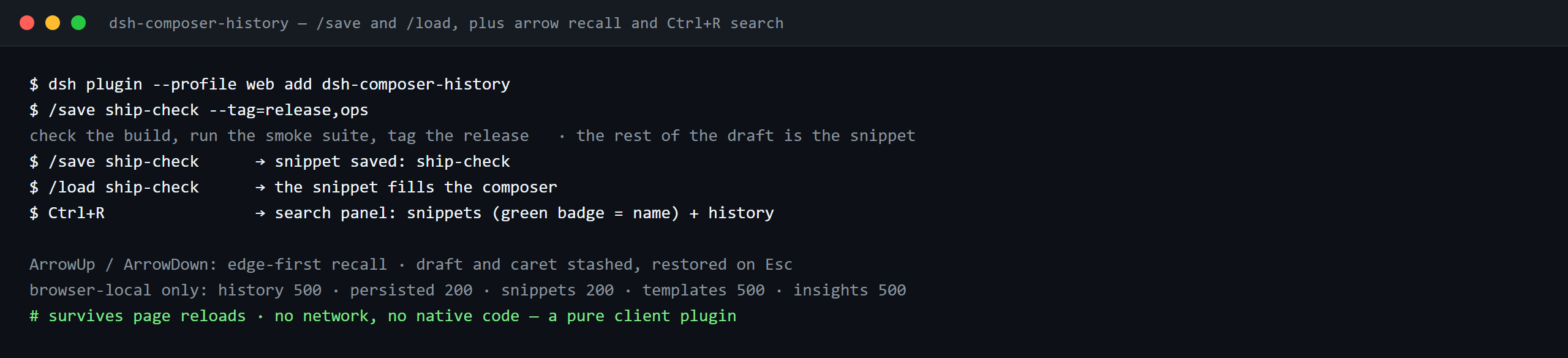
/save ship-check --tag=release,ops
check the build, run the smoke suite, tag the release        ← the rest of the draft is the snippet
/save ship-check                                             → "snippet saved: ship-check"
/load ship-check                                             → the snippet fills the composer
Ctrl+R → search panel lists snippets (green badge = name) alongside history
/save <name>consumes the Enter, stores the draft (minus the command line) under a kebab-case name with optional tags, and clears the composer. Nothing to save → an error notice, the command never sends./load <name>inserts the snippet at the caret (whole-draft replace, caret to end) and counts the use.- Scope: snippets saved with a workspace cwd are workspace-scoped; snippets saved without one are global.
maxSnippetsbounds the library; same-name saves replace. - The plugin never sends: every fill lands in the ordinary draft and your Enter stays yours.
Prompt templates with variables
Templates are stored prompt texts with {{variable}} placeholders. The search panel lists them with a purple badge; picking one fills the variables from the live session and inserts the result. Built-in variables: {{workspace}} (the session's cwd), {{session}} (the session id), {{draft}} (the current draft). A template referencing an unknown variable fails loudly with the missing list — a half-filled prompt is worse than an error.
The whole library — history, snippets, templates, and insights — exports to and imports from a single versioned JSON document through the panel's Export JSON / Import file actions; see Backup export & import below. An explicit user action; the plugin never writes files on its own.
Reuse insights
Every newly committed user message (and every snippet load) lands one browser-local usage record keyed by exact text. While you type, a small hint under the composer reports used M× in N sessions · 在 N 个会话里用过 M 次 once the draft matches a prompt used in at least insightMinUses (default 2) sessions. Toggle with enableInsights; the statistics contain only the deduped texts and counters.
Compaction summary highlight
Ctrl+R marks [compacted] … summaries with an amber badge (history stays unbadged), snippets green, templates purple — the panel's provenance is visible at a glance. Toggle with enableCompactionHighlight.
Backup export & import
All four browser-local libraries export to and import from one versioned JSON document. The panel's Export JSON / Copy JSON / Import file / Paste JSON actions run entirely in the browser: download or copy to clipboard on export, file pick or pasted text on import — nothing is uploaded and no host RPC or network call is involved.
Document shape
{
  "schemaVersion": 1,
  "exportedAt": 1735689600000,
  "data": {
    "history": ["…"],
    "snippets": [{ "name": "…", "text": "…", "tags": [], "scope": "global", "createdAt": 0, "updatedAt": 0, "useCount": 0, "lastUsedAt": 0 }],
    "templates": [{ "name": "…", "text": "…", "description": "", "updatedAt": 0 }],
    "insights": [{ "text": "…", "sessions": [], "uses": 0, "lastUsedAt": 0 }]
  }
}
Merge & conflict strategy
- History entries are plain strings and deduplicate by exact text; a duplicate or blank entry is skipped, never overwritten.
- Snippets and templates key on
name; insights key on exacttext. On a same-key conflict the newest timestamp wins (updatedAtfor snippets/templates,lastUsedAtfor insights); an older or equal-timestamp import is skipped, and new keys are appended. - The import respects
maxPersistedandmaxSnippets; templates and insights cap at their fixed protocol limits (500each). - The result notice reports how many records were written and how many were skipped (older/duplicate).
Schema versioning
schemaVersion starts at 1. Imports run a stepwise migration (one version at a time) so future formats can upgrade old documents in place. A document whose schemaVersion is newer than the one this build understands is rejected with an error — it is never silently dropped or partially merged; a version too old to migrate is rejected the same way.
Sliding context
The harness core gives every dsh session a sliding context window, the same workflow Claude Code and Codex ship: when a conversation approaches the model's context limit (or the provider reports an overflow), the harness auto-compacts — older turns are summarized behind a compaction checkpoint marker that stays visible in the transcript, the model keeps only the summary plus the recent tail, and the session continues. /compact triggers the same compaction on demand, and the marker renders as an expandable "Context compacted" row.
dsh-composer-history plugs the composer into that workflow so the window slide never costs you your typing history:
- Recall survives compaction — shadowed turns stay in the finalized conversation the Chat view publishes, so ↑ still walks every message you sent before and after a checkpoint.
- Summaries join the history — each checkpoint's summary text enters ↑ recall and
Ctrl+Rsearch as a[compacted] …entry (toggle:includeCompactionSummaries), so context the model no longer sees verbatim stays one keystroke away. - Compaction notice — when a checkpoint lands while the page is open, a transient snackbar announces it (the Claude Code "Auto-compacting conversation…" moment) with the summary snippet and a one-click Fill
/compactaction (showCompactionNotice,compactCommandText); the fill lands in the ordinary draft, and only your Enter sends it. - Search counts — the
Ctrl+Rpanel now shows a liveN entries/N matchesstatus line, and long entries are clamped to two lines.
Compaction itself (thresholds, summary model,
/compact) is owned by the harness core's compaction plugins — this plugin only observes the checkpoint markers the Chat view's conversation projection already publishes (uiConversation.binding(id).target('chat').legacy.nodes), so it works without any agent-loop or model-request changes.
Permissions & data
- Permissions: the plugin declares
browser:local-storagein its workshop manifest — nothing else. No network, no subprocesses, no session events. - Data: four browser-local
localStoragekeys —dsh.composer-history.v1(sent-message history),dsh.composer-history.snippets.v1(snippet texts + tags + use counters),dsh.composer-history.templates.v1(template texts), anddsh.composer-history.insights.v1(deduped prompt texts + per-session use counters). All bounded, same-origin only, never uploaded; corrupt payloads reset silently. - Model-visible ⟺ you press Enter: recalled text, snippet loads, template fills, and the
/compactfill all land in the ordinary composer draft. Nothing reaches the model until you press Enter.
Security boundaries
- UI-only, never enforcement. The plugin edits the composer draft only; the sandbox, approval, and session systems remain the enforcement authorities, and no command or tool is ever claimed or bypassed.
- No content leaves the browser except an explicit export. History, snippets, templates, and insights live in
localStorage; nothing is uploaded, and no model request or network call is made. The versioned backup export only writes a local download or the clipboard on an explicit click. - Fail loud. Invalid enum values fail the whole dsh boot; a malformed search chord fails the browser fiber — misconfiguration never silently degrades.
- Bounded everything.
maxHistory,maxPersisted, andmaxSnippetscap retained entries; corrupt or foreign payloads reset silently. - Zero side effects on pass-through. The plugin intercepts only in the
plaininput phase and yields to the slash menu, command popups, IME composition, text selections, and modifier combos.
Known limitations
- Composer DOM face. Interception anchors on host-private DOM: the contenteditable
div[data-composer-input]inside[data-input-scroll](harness 0.1.2-alpha.5 / 0.1.2-rc.1 and later); the legacy textarea composer inside[data-input-scroll](lines up to 0.1.1-rc.2) stays matched. This shape is not a published API (upstream proposal C3 records that plugins can only guess host DOM), so a future host DOM change can break interception silently — the compat workflow's jsdom smoke re-asserts the face against the packed bundle. - Logical vs visual lines. Default
logicalkeys off\n(a long auto-wrapped message counts as one line);visualmeasures real wraps via a hidden mirror that copies the contenteditable surface's computed box (O(lines·log n) binary search per edge check, memoized per draft/width). Mirror measurement needs a real layout engine — the pure span math is unit-tested instead, and measured spans on the Lexical composer stay best-effort (logical remains the default). - Persisted history is per-browser. The store lives in one origin's
localStorage; it never syncs between browsers or machines. Corrupt payloads reset silently. - Undo stack includes recall transactions. Every fill/restore is one
setDrafttransaction in the input machine's undo log; Ctrl+Z steps back through recalls. The precision fix needs the upstream edit-range exposure. - Recalling a
/xxxentry then Enter follows the normal command claim/adjudication path (expected, and Enter is never intercepted). - Menus/popups and non-
plainphases always win; a committed send and session switches both reset to IDLE. - Reference chips (U+FFFC placeholders) ride along with recalled/restored draft text.
historyScope: 'workspace'reads the Chat targets of other listed sessions; a session whose Chat view has not been activated in this page contributes nothing yet.- The search overlay is plain DOM (no React dependency); it renders all matches up to the
maxHistorybound. - Compaction awareness is observational. Checkpoints landed before install (or before a session switch) never trigger a notice; a checkpoint whose summary event fell outside the loaded window contributes no
[compacted] …entry (summary: null). - The notice's "Compact now" action only fills the configured command text into the draft — sending remains the user's Enter.
- Snippets, templates, and insights are browser-local. Names are kebab-case (1..64 chars); tags cap at 8 × 32 chars. Template variables resolve from the live session;
{{draft}}is the draft at pick time.
Development
pnpm install           # node ^22.19 || >=24
pnpm run build         # tsc build + tsdown bundle (lib/)
pnpm run typecheck     # tsc --noEmit (src + tests)
pnpm test              # vitest run
pnpm run test:watch    # vitest watch
pnpm run test:coverage # vitest run --coverage
pnpm run check:readmes # README consistency gate
pnpm run verify:pack   # pack-surface check
Topics
deepseek-harness · dsh · dsh-plugin · web-gui · input-history · keyboard-shortcuts · compaction · sliding-context · typescript
Contributors
- @PerryLink — creator and maintainer: edge-first arrow recall, persisted history, reverse search, sliding-context awareness, snippet library, prompt templates, reuse insights, and the
dsh.bundle/dshWorkshopmanifests.
PerryLink DSH Plugin Family
This project is one of the 33 actively maintained DeepSeek Harness plugins from PerryLink — the roster is 42, of which 6 are frozen and 3 retired; every one keeps its row below, with the reason in the Status column. If this one helps you, the others likely will too:
| Plugin | One-liner | Status |
|---|---|---|
| dsh-auto-review | Second-model auto-review on the approval chain, fail-closed by default | |
| dsh-autotier | Automatic strong/cheap model-tier routing with deterministic risk guards and a /tier command | |
| dsh-background-agents | Durable background child agents with a Web UI sidebar, messaging and interrupt | 🚫 RETIRED — see the note above |
| dsh-budget | Cost governance for DeepSeek Harness: budgets, carbon, and latency in one panel. | 🧊 FROZEN — see the repo README |
| dsh-catalog | DSH Desktop Market standard catalog source for the PerryLink family | |
| dsh-cert-mcp | Read-only MCP server exposing the certification registry: grades, snapshots and five-dimension evidence | |
| dsh-checkpoint-rewind | Claude Code /rewind-equivalent: snapshots, session forks, one-shot restore | |
| dsh-claude-move | Migrate Claude Code sessions, memory, skills and CLAUDE.md into DSH | 🧊 FROZEN — see the repo README |
| dsh-click | Cross-platform native desktop control for DeepSeek Harness — Windows first. | |
| dsh-composer-history | Terminal-style input history for the web composer: arrows, Ctrl+R search | |
| dsh-data-quality | Dataset quality checks and citation cross-checks (the optional numeric bridge consumed here) | |
| dsh-defend | Prompt-injection, jailbreak, and secret-leak defense for DeepSeek Harness. | 🧊 FROZEN — see the repo README |
| dsh-doublecheck | Engineering-discipline guard: requirements grill, test gates, adversary review | |
| dsh-draw | Unified static-image generation routing for DeepSeek Harness. | 🧊 FROZEN — see the repo README |
| dsh-fast | Read-only performance diagnostics for DeepSeek Harness. | |
| dsh-fund-research | Deterministic research reports for Chinese public mutual funds | |
| dsh-github | GitHub PR/issues integration for DSH, every write gated by approval | |
| dsh-industry-research | Industry research orchestration that seals its deliverables through this plugin's ctx.researchReport.assemble | |
| dsh-laya | Laya typed decisions (noul/choice/score) as a first-class Cordis service and model-visible tools | |
| dsh-library | Local document knowledge base for DeepSeek Harness. | |
| dsh-local-ai | Local-model (Ollama) integration for DeepSeek Harness. | |
| dsh-lsp-actions | LSP diagnostics, formatting, completion, code actions and rename over language servers | |
| dsh-mask | PII masking middleware: anonymize at the model boundary, restore at the display layer | |
| dsh-mcp-panel | Read-only MCP runtime panel: /mcp command + Settings tab with status, tools and errors | |
| dsh-memento | Approval-gated cross-session memory: ctx.memory seam + SQLite + memory tool | 🧊 FROZEN — see the repo README |
| dsh-observe | OpenTelemetry and Langfuse observability exporter for DeepSeek Harness. | |
| dsh-output-styles | Claude Code outputStyles-equivalent runtime style switching | |
| dsh-permission-rules | Claude Code-style declarative allow/deny/ask permission rules with audit | |
| dsh-plugin-certification | Community certification registry with repro-checkable grades and badges | |
| dsh-plugin-doctor | Zero-dependency static + sandbox smoke detector for DSH plugins | |
| dsh-plugin-guide | Plugin-development knowledge base as an on-demand agent skill | |
| dsh-plugin-kit | Shared zero-runtime-dependency toolkit for the PerryLink DSH plugins | |
| dsh-plugin-upgrade | One-package, one-corridor-index plugin upgrade skill: routes a repository to the matching closed corridor card | |
| dsh-plugin-upgrade-015 | Merged 0.1.3-alpha.1 → 0.1.5-rc.1 upgrade corridor card plus a zero-dependency seam scanner | 🚫 RETIRED — corridors carried by dsh-plugin-upgrade |
| dsh-reach | Multi-channel approval/question bridge: WeChat/Telegram/Feishu, session console | 🧊 FROZEN — see the repo README |
| dsh-research-report | Verifiable research-report engine: content-addressed evidence ledger and sealed versions | |
| dsh-score | Multi-dimensional quality scoring for DeepSeek Harness plugins. | |
| dsh-session-pin | Pin sessions in the Web sidebar with durable ordering | 🚫 RETIRED — see the note above |
| dsh-session-sync | Cross-device session sync for DeepSeek Harness — a dedicated git mirror of your session store. | |
| dsh-skill-pack-security | Security-audit skill pack: secret scan, dependency and supply-chain review | |
| dsh-talk | Voice-first session loop for DeepSeek Harness: talk to it, hear it answer. | |
| dsh-team-rooms | Cross-session team rooms: shared message bus, task board and timeline | 🚫 RETIRED — see the note above |
| dsh-test-drive | Isolated install-and-smoke test drives for DeepSeek Harness plugins. | |
| dsh-ticktick | TickTick/Dida365 task bridge: session-header panel + 11 tools | |
| dsh-translate | Vendor parameter translation and deterministic JSON repair for DeepSeek Harness. |
Install from the DSH Desktop Market
All PerryLink plugins are browsable in the built-in DSH Desktop Market: Market → Sources → add source → paste https://perrylink-dsh-catalog.perrylink.workers.dev/catalog-source.json → select it. Installation still goes through the Market's npm-identity verification and your confirmation.
License
Apache License 2.0 © 2026 dsh-composer-history contributors


