
dsh-assembler
Agent & WorkflowTT-Wang/dsh-assembler
Assemble a working AI agent from one sentence and hand it over, using a capability catalog and induction pipeline.
- dsh-plugin
Verification and compatibility
This section shows evidence collected by the catalog. Undeclared information is labeled as unknown.
- Current-version compatibility
- Verified on the catalog Harness version
- Declared Harness range
- Not declared
- Declared platforms
- Not declared
- Profiles
- web
- Build approval
- Unknown
- Permissions
- Not declared
- External services
- Not declared
- Telemetry
- Unknown
This is not a security endorsement. Review source, permissions, and configuration before installing.
View evidence and scope
Verification covers only the named source, version, and Harness environment. It does not guarantee future compatibility.
github:TT-Wang/dsh-assembler#02f74ca0bcf8e10a855835e696c3b565cf8889bf- The manifest and static structure passed checks; a runtime load check has not completed.
README
dsh-assembler — Vibe Assembly for DSH
English | 中文
Assemble a working AI agent from one sentence — and be able to hand it over.
dsh-assembler is a DeepSeek Harness (DSH) plugin. You describe the agent you want in plain language ("build me a support bot that can look up orders, open tickets, and hand off to a human"); the assembler matches parts from a capability catalog, emits an agent preset, and then proves it works by running it in a real session. New sessions pick that preset from the roster and go.
The catalog grows through an induction pipeline: open-source libraries, public APIs, a client's own HTTP interfaces, and a client's documents all enter through one command each — and only past a quality gate. No glue code, only configuration.
How it works, from your seat: you describe the agent you want in one sentence. The assistant first shows you the architecture — capabilities, data model, workflow, and any gaps the catalog cannot cover (each gap is your call: build the missing part on the spot, degrade, or drop it) — and waits for your go-ahead. Parts are then found by instant catalog search, with every candidate priced (what its manual adds to the agent's prompt each turn, whether it spawns a process, which credentials it needs). The preset is emitted deterministically with every safety gate intact, and an independent examiner proves it works by running it in a real session before it reaches you — together with its web page, a supply-chain BOM, and a self-check pack it can re-run after any later change.
No graduation penalty: everything is a real, inspectable artifact — parts are ordinary processes with pinned provenance, a delivered agent is a git-diffable text composition plus its BOM, and the execution layer is framework-agnostic. Outgrow the assembler and you keep everything: the parts keep running, the presets keep mounting, nothing is held hostage.
At a glance
| Catalog | 103 parts / 311 tools — 71 library-backed, 27 service-backed, 5 first-party (index/catalog.yml) |
| Verification | every assembly ends with an independent black-box probe in a real session; every web page passes a reachability gate and a live-session loop gate |
| Wall time | a single agent typically lands in minutes, verification included |
What it does
- Just talk — describe the agent in any DSH session. The assistant reviews the architecture with you (gaps included — each one is your decision), finds parts by instant search, assembles, and hands over only what an independent probe has verified.
- Assemble-then-verify — after emitting a preset, the assembler derives an acceptance probe, runs it in a real session bound to that preset, and judges the reply against content-bearing marks. A FAIL comes back with evidence — which turn, which missing acceptance mark, what the agent actually replied — so the fix is surgical (swap a part, tighten the persona, re-emit under the same name) rather than a blind retry; a PASS also drops a
selfcheck.jsonbeside the preset, so the agent can be re-examined with the same probe after any later change.find → assemble → **verify**, on by default. The probe fails fast and honestly: an agent that asks the (absent) user for help is scored FAIL with the question quoted back, and every probe turn narrates its tool actions live. - Multi-turn scenario probes — the deriver picks the probe shape itself: one turn for pure-compute agents, a 2–4 turn scenario when the requirement implies work that outlives a turn (bookkeeping, filing, tracking). Scenario turns run in one session, and a later turn queries what an earlier turn wrote. Judgement stays black-box: replies only, never the trajectory.
- Multi-agent teams — ask for a suite ("one agent for support, one for reconciliation, one for inventory — all on the same product/order data") and the agents are assembled one by one against one shared database, then the handoff itself is proven: an independent probe has one agent write a record and a different agent read it back.
- Gap work orders — when selection reports a capability the catalog cannot yet cover, the assembler writes an actionable work order to
<preset>/gaps/: the spec, the real induction-pipeline commands to build the missing part, and the exact re-assemble command that closes the loop. The writing of the missing part is handed to the calling agent (which has a full coding harness); the assembly spine stays deterministic, and the verdict always comes from the assembler's own black-box probe. - Assembly console (live) — every assembly dual-writes its action chain to
<preset>/progress.log; a live console page (/assembler/ui/_console) polls it so a slow assembly is a visible, timestamped trail — "stuck or working?" answered at a glance — not a silent spinner. Selection, emission, probe rounds, per-turn tool actions and a 20s heartbeat all scroll there. - Knowledge packs (
via: knowledge) — a client's manuals, SOPs and product catalogues enter as static teaching material, past a retrieval-hit gate (a probe question whose expected snippet cannot be found is refused), and are copied into the preset'skb/at assembly time. The handover is one self-contained directory. - Credential contract (interface first, key later) — parts declare the environment variable they need and what it is for; the value never enters a preset. Unconfigured, a part still starts,
listToolsstill succeeds, and a call returns an actionable error (which variable, what for, where to get it). On the assembly side: assembly succeeds, the probe degrades to SKIPPED with configuration guidance. Optional credentials (GitHub public reads, polite-pool mailtos) take the anonymous path and do not hold verification back. - Client-private catalogs —
catalogs/<client>/carries its owngenerated/,index/,capabilities.ymlandknowledge/. One client's parts cannot surface in another's assembly, because isolation is by separate files, not by a filter someone can forget. - Service-backed parts — 13 live data services are wired in (weather, FX, geocoding, holidays, macro data, SEC filings, scholarly search, wiki facts, research graph, package intel, Feishu, Slack, GitHub Issues). A library part pins
repo@rev; a service has no bytes to pin, so it pins terms + rate limit + data licence instead — and those travel into the BOM, because a client's compliance desk asks about them first. - Parts BOM — every assembly emits
parts.lock.ymlbeside the preset: per part its origin, licence, verified status and the serverName actually mounted, plus knowledge sources with versions and the pending-credential list. - Federation cache — each part's tool list is cached under (connection config + adapter file fingerprint): cold ~5s, warm 0.002s.
- persona lint — mechanical checks on the persona text: every tool it names must be in the mounted surface, step-numbered choreography is rejected, length is bounded.
- Constitution & design notes — docs/CONSTITUTION.md (vibe assembly governed as a programming language, nine articles each with a test) · DESIGN.md states what the assembler does, what it deliberately does not, and where the boundary sits.
Every assembly ships a web UI
Assembly does not stop at the preset — every agent also gets an operable web frontend, served same-origin by the assembler on the host (/assembler/ui/<preset>). The page speaks the host's public wire (session.create / session.prompt / events.mux) and shares the same agent and the same durable workspace as the DSH conversation view; it pulls current state on open.
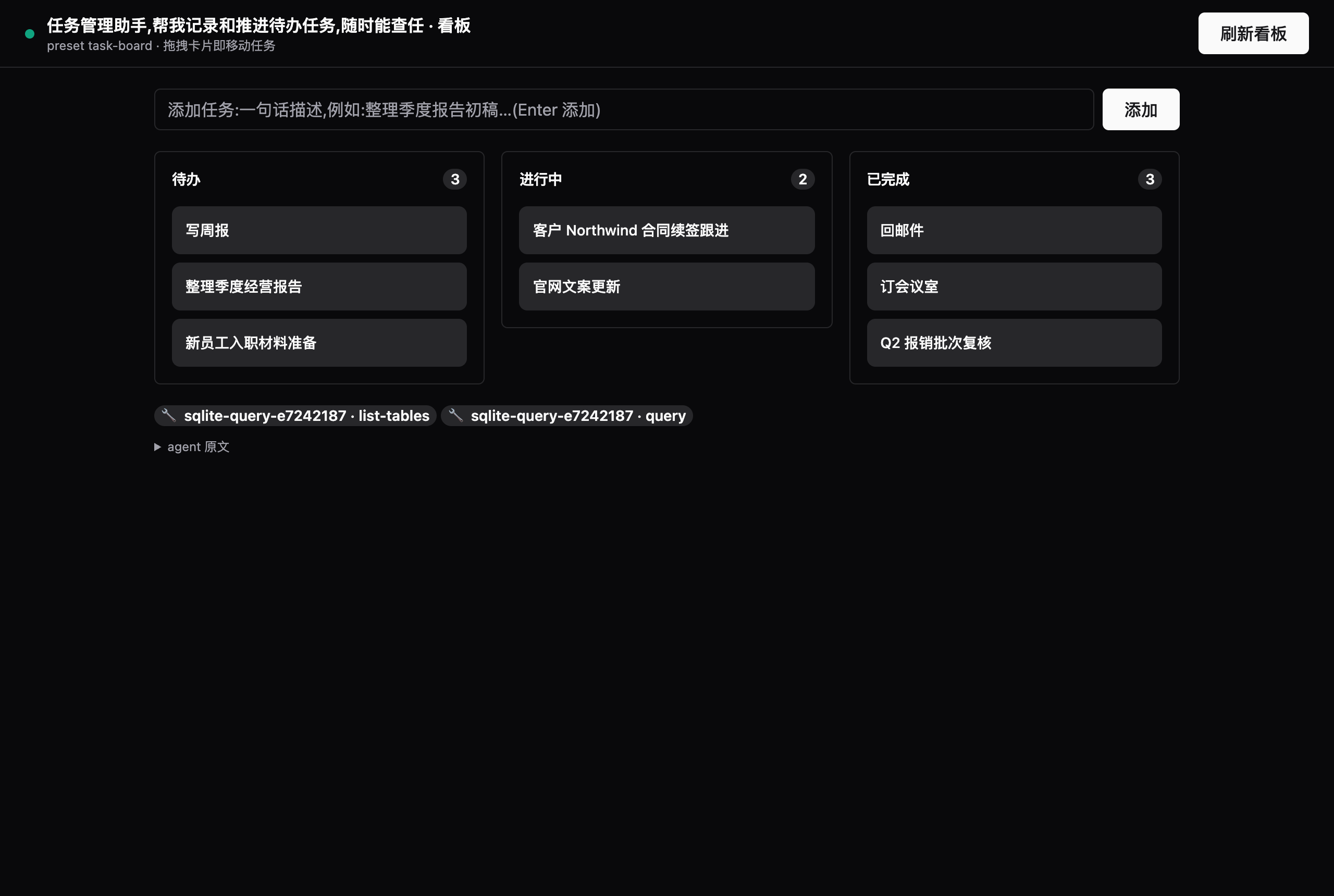
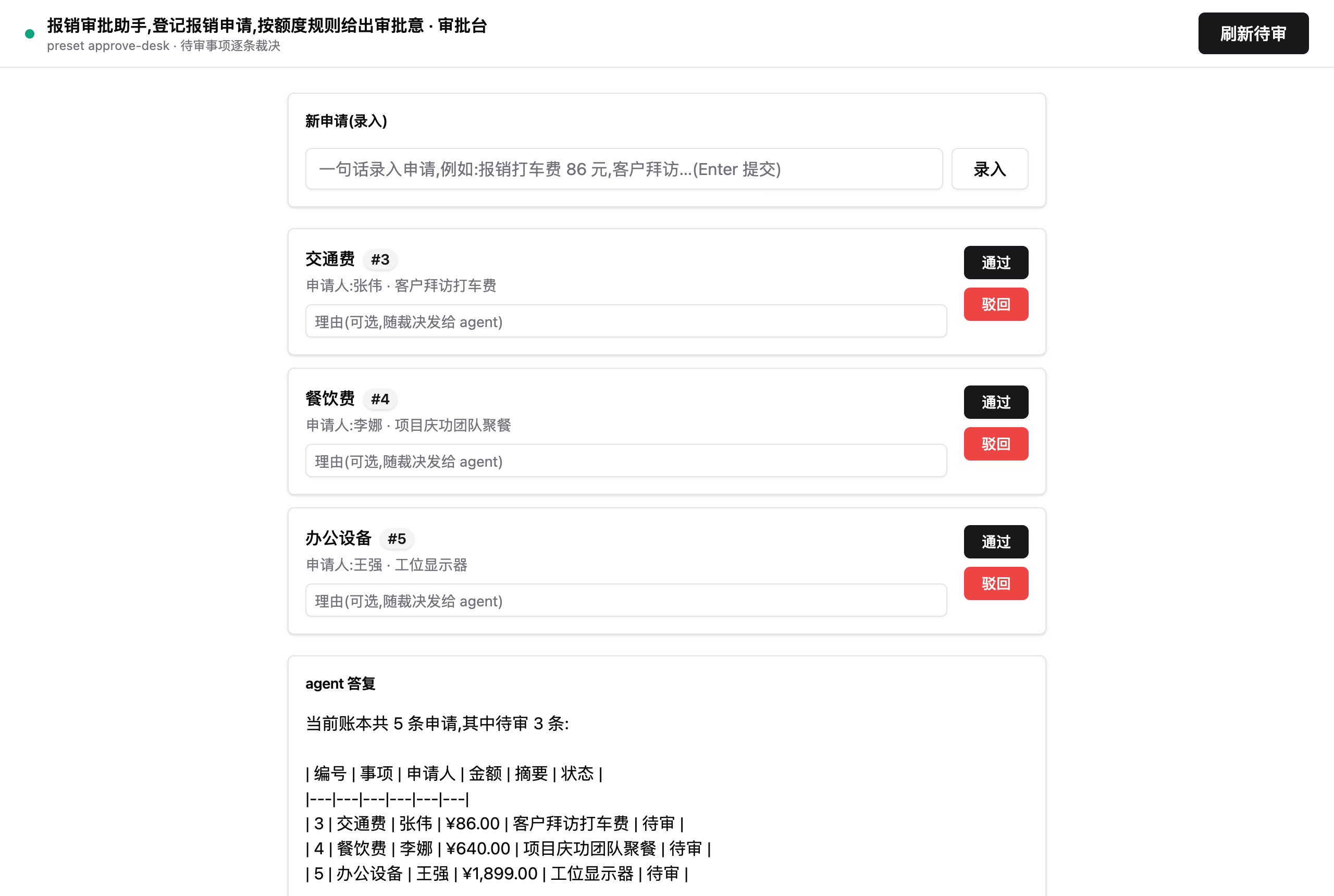
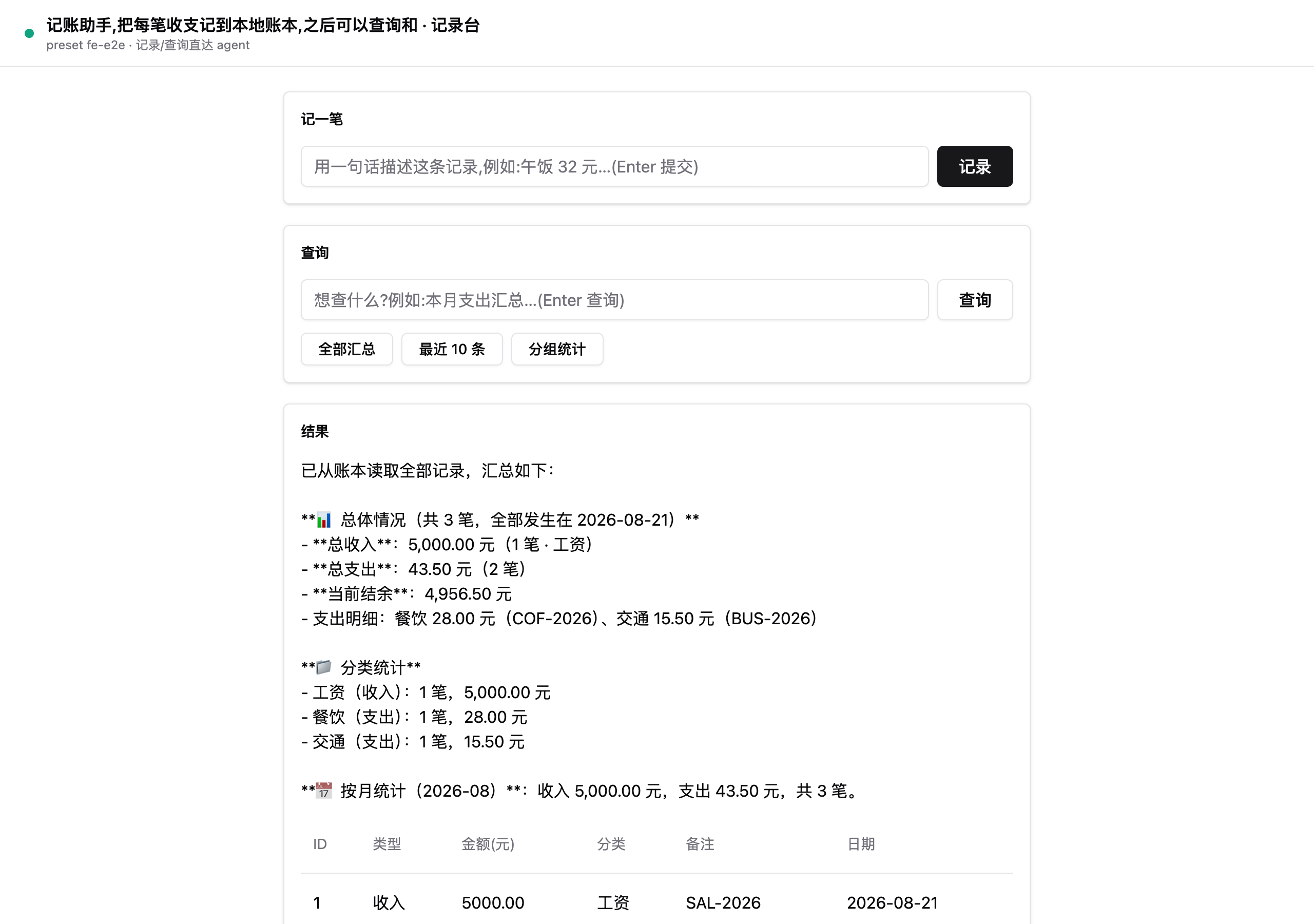
Each screenshot below is the real product of a single assembly (real assembly, real data, real capture — verdict lines quoted verbatim):
任务管理助手 … 要一个可以拖拽的任务看板页面→ 自动验证:PASS · 前端验收:页面门+环路门 PASS

How it works:
- Frontend template parts (
via: frontend) — 7 templates: chat console (default for every preset), form desk, data desk, dashboard, drag-and-drop kanban, approval desk, file desk; the matcher picks exactly one by interaction shape - Look — built on Franken UI (the no-build HTML port of shadcn/ui, MIT), vendored locally — zero CDN dependency for offline/intranet delivery; auto light/dark
- Page↔agent contract — pages embed a ```json fence contract in their prompts (no persona coupling); replies render as boards/tables/stat cards
- Frontends are verified too — assemble-then-verify gains two frontend gates: page gate (HTTP 200 + slots filled) and loop gate (a real session opened with the page's exact parameters must echo a token); carried runs re-run the page gate only
- One durable ledger — the equipment lane pins the default database (workspace
data.db) and pre-builds its schema, so frontend sessions and DSH conversations write the same store - Pages the templates can't cover get written — the scaffold writer's seat:
emit_applays down a locked-vocabulary frontend skeleton (Vite + React + shadcn/ui + a fixed comms SDK, with record-desk and kanban starter pages you can copy whole), the assistant writes any page shape inside the single free zonesrc/pages/against a PAGE-SPEC (every action routed face/wire/ai-thin/local);verify_appexamines black-box through five gates (build / skeleton-lock / pages-lint / asset reach / behavior: face actions really execute SQL with effect assertions, wire actions run real-session probes), anddeploy_apppublishes into the preset same-origin with a snapshot for one-call rollback. Measured: a custom kanban's face round-trip at 5.1ms; the page and the chat sessions still share one ledger (two-faced delivery), the handoff proven by an independent examiner (one face writes, the other reads back)
Architecture
┌───────── Induction pipeline (supply chain) ────────────────────────────┐
│ OSS library / public API / client OpenAPI / client documents           │
│   → slice capabilities → MCP adapter → gate (smoke / retrieval) → catalog │
└───────────────────────────────────────────────────────────────────────┘
                              ↓
┌───────── Assembly (capability consumption) ───────────────────────────┐
│ capabilities.yml (public or client) + parallel federation             │
│   → instant parts search (priced candidates) → orchestrator decides   │
│   → deterministic emission + BOM + knowledge copied into kb/          │
│   → independent verification: probe in a real session → PASS/FAIL     │
└───────────────────────────────────────────────────────────────────────┘
                              ↓
┌───────── Delivery (FDE) ──────────────────────────────────────────────┐
│ multi-agent suite: emit_preset per agent, pinned to one sharedDb      │
│   → verify_shared_data handoff exam (one writes, another reads back)  │
│   → every agent carries its own parts.lock.yml BOM record             │
└───────────────────────────────────────────────────────────────────────┘
                              ↓
┌───────── Runtime (the harness's territory) ───────────────────────────┐
│ session picks the preset → DSH mounts each row → agent calls the parts │
└───────────────────────────────────────────────────────────────────────┘
The assembler is a Cordis plugin and its output is a Cordis composition manifest (one preset row = one plugin instance); parts are external MCP server processes bridged by @deepseek-ai/dsh-mcp-client. The assembler exists only at assembly time — once a session is running its process is gone and nothing changes.
Quick start
1. Install
Add the plugin to a DSH profile's patch layer (e.g. ~/.dsh/profiles/web/cordis.patch.yml):
- insert:
    - id: dsh-assembler
      name: '@dsh-external/dsh-assembler'
Dependency: "@dsh-external/dsh-assembler": "link:/path/to/dsh-assembler".
Some service parts need the operator's contact details (SEC mandates a contactable User-Agent; Crossref/OpenAlex polite pools want a mailto). Copy .env.example to .env and fill in your own — not credentials, but not anyone else's address either.
2. Assemble one agent
Open the DSH web UI and just say it:
帮我装配一个记账 agent:随手记收支,按月汇总,能设预算超支提醒,有查账网页
You will be shown the architecture (and any catalog gaps, each yours to decide) before anything is built; after your go-ahead the agent assembles, an independent probe verifies it in a real session, and you get the preset id, the verdict with evidence, and a web page at /assembler/ui/<preset>. Artifacts land in ~/.dsh/.agent-presets/<preset>/ — parts.lock.yml (BOM), selfcheck.json, progress.log.
3. Deliver a whole team (the FDE path)
Just ask for a suite of agents in one session — "give me a set of ops agents: one for support, one for reconciliation, one for inventory, one for content, all sharing the same product/order data". The assistant splits the request into focused agents, assembles and verifies each (emit_preset pins every member to one shared sharedDb), and the handoff itself is examined independently (verify_shared_data: one agent writes a record, a different agent reads it back — the reader's instruction may not contain the answer, the copy gate). Each agent's parts.lock.yml is its delivery record: verdict, part provenance, pending credentials, knowledge versions — all grown from artifacts.
Layout
dsh-assembler/
├── src/
│   ├── index.ts            # assembly core: catalog, federation, deterministic emission, BOM, equipment, knowledge
│   ├── orchestrated-tools.ts # the tool surface: parts search · deterministic emit · independent examiner
│   ├── verify.ts           # assemble-then-verify: probe machinery (single/scenario) + real-session driver
│   ├── capability-index.ts # BM25 parts search backend
│   ├── persona-lint.ts     # mechanical persona checks
│   ├── frontend.ts         # frontend lane: template emission + same-origin route + live console
│   └── client/             # browser half: assembly console tab in the DSH sidebar
├── capabilities.yml        # ★ public catalog: capability entries + mcp-servers + requiredSecrets
├── index/                  # ★ public part index (origin/licence/terms) + smoke reports
├── generated/              # ★ part library: 80+ MCP adapter servers, one directory each
├── catalogs/<client>/      # ★ client-private catalog: its own generated/ index/ capabilities.yml knowledge/
├── bench/results/          # assembly-quality ledgers (run-tagged, committed)
├── presets/
│   └── agent-template.yml  # preset template ({{persona}}/{{packageRows}}/{{extraRows}}/{{param:k}})
└── scripts/
    ├── index-add.mjs       # ★ induction pipeline CLI
    └── link-dsh.mjs        # link DSH peer packages
The capability catalog
Four kinds of capability:
via | Source | Example |
|---|---|---|
package | a tool from this repo / an own plugin package | crm-query |
harness | a DSH built-in tool | content-search |
mcp | MCP server tools (federated at assembly time) | mcp-weather-forecast-current-weather, 229 of them |
knowledge | client teaching material (copied into kb/) | acme-policies-kb |
103 parts / 311 tools — 71 library-backed, 27 service-backed, 5 first-party.
Service-backed parts — live data and external systems
| Part | Tools | Source | Licence / terms | Credentials |
|---|---|---|---|---|
| package-registry | package-info package-versions check-license | npm + PyPI registries | registry ToS | none |
| weather-forecast | current-weather daily-forecast | Open-Meteo | CC-BY-4.0 | none |
| currency-rates | latest-rates historical-rate convert-amount | Frankfurter (ECB data) | Public-Domain-ECB | none |
| geocode | geocode-address reverse-geocode | OpenStreetMap Nominatim | ODbL-1.0 | none |
| public-holidays | list-holidays is-workday available-countries | Nager.Date | MIT | none |
| worldbank-data | country-indicator common-indicators | World Bank Open Data | CC-BY-4.0 | none |
| sec-filings | lookup-cik company-filings | U.S. SEC EDGAR | Public-Domain-US-Gov | none |
| scholar-search | search-published search-preprints doi-lookup | Crossref + arXiv | CC0-1.0 / arXiv terms | none |
| wiki-facts | page-summary search-entity entity-facts | Wikimedia (Wikipedia + Wikidata) | CC-BY-SA-4.0 | none |
| research-graph | search-works work-citations author-works | OpenAlex | CC0-1.0 | none |
| feishu-messaging | send-message list-chats feishu-capabilities | 飞书开放平台 | Feishu API ToS | FEISHU_APP_ID FEISHU_APP_SECRET |
| slack-messaging | post-message list-channels slack-capabilities | Slack API | Slack API ToS | SLACK_BOT_TOKEN |
| github-issues | list-issues get-issue create-issue github-capabilities | GitHub REST API | GitHub ToS | GITHUB_TOKEN (optional) |
First-party parts — thin shells over Node built-ins, zero third-party deps
binary-write(write-binary-file) · crypto-hash(hash-text, hmac-sign, generate-uuid) · compress-gzip(compress, decompress) · dns-lookup(resolve-domain, reverse-lookup) · book-intake(browser→workspace file channel + epub parsing) · webhook-intake(inbound event intake) · ai-call(standalone AI completion for apps) · static-deploy(publish a built site as an agent page) · app-scaffold(official create-vite scaffolding)
Library-backed parts, by domain
| Domain | Parts (tool count) |
|---|---|
| Documents & office | pdf-generate(4) · pdf-extract(3) · pdf-report(1) · docx-generate(3) · docx-extract(2) · pptx-generate(1) · excel-read-write(4) · zip-archive(4) |
| Data formats | csv-parse(3) · yaml-convert(2) · toml-parse(2) · xml-parse(3) · json-query(2) · json-schema-validate(2) · html-parse(4) · html-to-text(4) |
| Text processing | markdown-render(3) · html-to-markdown(1) · readability-extract(2) · text-diff(3) · template-render(4) · fuzzy-search(4) · text-encoding(2) |
| Chinese language | pinyin-convert(2) · chinese-convert(2) · word-segment(2) · num-to-chinese(2) |
| Computation | math-eval(2) · currency-calc(4) · number-format(4) · semver-check(3) · geo-distance(3) · color-convert(2) |
| Time & calendars | date-format(4) · cron-parse(2) · calendar-parse(3) · calendar-generate(4) · rrule-expand(2) |
| Databases | sqlite-query(3) · mysql-query(4) · postgres-query(4) |
| Network & messaging | http-request(4) · email-send(4) · email-fetch(4) · rss-parse(4) |
| Media & recognition | image-process(4) · ocr-parse(3) · qrcode-generate(4) · barcode-generate(2) · exif-read(1) · file-type-detect(1) |
| Security & validation | jwt-decode(2) · ip-utils(2) · string-validate(2) · fake-data(2) · phone-parse(2) |
| Engineering tools | github-api(4) · browser-automate(4) · url-slugify(3) · transliterate(2) · safe-filename(2) |
- email-send —
send-email,verify-smtp-config,parse-email-addresses,create-test-accountnodemailer/nodemailer@v6.9.13 · MIT - email-fetch —
list-mailboxes,search-messages,fetch-message,list-message-summariespostalsys/imapflow@v1.0.162 · MIT - http-request —
http-request,http-get,http-post,build-urlaxios/axios@v1.7.2 · MIT - html-parse —
extract-text,extract-attributes,query-elements,serialize-htmlcheeriojs/cheerio@v1.0.0-rc.12 · MIT - csv-parse —
parse-csv,unparse-csv,validate-csvpapaparse/papaparse@5.4.1 · MIT - pdf-generate —
create-pdf,merge-pdfs,extract-pages,pdf-infoHopding/pdf-lib@v1.17.1 · MIT - date-format —
format-date,parse-date,date-diff,date-manipulateiamkun/dayjs@v1.11.11 · MIT - sqlite-query —
query,execute,list-tablesWiseLibs/better-sqlite3@v11.1.2 · MIT - github-api —
get-user,get-repo,list-org-repos,search-repositoriesoctokit/rest.js@v20.1.1 · MIT - markdown-render —
render-markdown,render-markdown-inline,tokenize-markdownmarkedjs/marked@v12.0.2 · MIT - pdf-extract —
get-pdf-text,get-pdf-info,search-pdf-textpdf-parse/pdf-parse@1.1.1 · MIT - excel-read-write —
read-xlsx-file,write-xlsx-file,read-csv-file,write-csv-fileexceljs/exceljs@v4.4.0 · MIT - docx-generate —
docx-generate-text,docx-generate-table,docx-patch-documentdolanmiu/docx@8.5.0 · MIT - zip-archive —
zip-list-entries,zip-read-file,zip-create-archive,zip-update-archivecthackers/adm-zip@v0.5.12 · MIT - fuzzy-search —
fuzzy-search,fuse-create-index,fuse-search-with-index,fuse-configkrisk/Fuse@v7.0.0 · Apache-2.0 - template-render —
render-template,precompile-template,render-precompiled,validate-templatehandlebars-lang/handlebars.js@v4.7.8 · MIT - html-to-text —
html-to-text,html-to-text-batch,html-to-text-table,html-to-text-linkshtml-to-text/node-html-to-text@9.0.5 · MIT - xml-parse —
xml-validate,xml-parse,xml-buildNaturalIntelligence/fast-xml-parser@v4.4.0 · MIT - image-process —
image-info,image-resize,image-convert,image-thumbnaillovell/sharp@v0.33.4 · Apache-2.0 - rss-parse —
parse-rss-string,parse-rss-url,extract-feed-items,parse-feed-metadatarbren/rss-parser@v3.13.0 · MIT - calendar-parse —
parse-ics,parse-ics-file,fetch-ics-urljens-maus/node-ical@0.19.0 · Apache-2.0 - calendar-generate —
create-calendar,create-event,create-all-day-event,create-recurring-eventsebbo2002/ical-generator@v7.1.0 · MIT - mysql-query —
mysql-query,mysql-list-tables,mysql-describe-table,mysql-test-connectionsidorares/node-mysql2@v3.10.0 · MIT - number-format —
format-number,unformat-number,arithmetic,validate-numberadamwdraper/Numeral-js@2.0.6 · MIT - qrcode-generate —
qr-generate-png,qr-generate-data-url,qr-generate-svg,qr-generate-terminalsoldair/node-qrcode@v1.5.3 · MIT - postgres-query —
postgres-test-connection,postgres-list-tables,postgres-describe-table,postgres-querybrianc/node-postgres@pg@8.12.0 · MIT - browser-automate —
browser-open,browser-extract,browser-click,browser-screenshotmicrosoft/playwright@v1.45.0 · Apache-2.0 - ocr-parse —
ocr-languages,ocr-psm-modes,ocr-recognizenaptha/tesseract.js@v5.1.0 · Apache-2.0 - currency-calc —
currency-calc,currency-format,currency-distribute,currency-parsescurker/currency.js@v2.0.4 · MIT - readability-extract —
extract-article,extract-batchmozilla/readability@0.5.0 · MIT - pdf-report —
create-report-pdfHopding/pdf-lib@v1.17.1 · MIT - binary-write —
write-binary-filefirst-party@- · BSD-3-Clause - text-diff —
create-patch,apply-patch,diff-wordskpdecker/jsdiff@v9.0.0 · BSD-3-Clause - crypto-hash —
hash-text,hmac-sign,generate-uuidfirst-party@v- · BSD-3-Clause - math-eval —
evaluate,unit-convertjosdejong/mathjs@v15.2.0 · Apache-2.0 - cron-parse —
next-runs,describe-fieldsharrisiirak/cron-parser@v5.10.0 · MIT - semver-check —
compare,satisfies,coerce-validnpm/node-semver@v7.8.5 · ISC - yaml-convert —
yaml-to-json,json-to-yamleemeli/yaml@v2.9.0 · ISC - pinyin-convert —
to-pinyin,multi-tonezh-lx/pinyin-pro@v3.29.2 · MIT - chinese-convert —
s2t,t2snk2028/opencc-js@v1.4.1 · MIT AND Apache-2.0 - html-to-markdown —
html-to-markdownmixmark-io/turndown@v7.2.4 · MIT - text-encoding —
decode-base64,encode-to-base64ashtuchkin/iconv-lite@v0.7.3 · MIT - phone-parse —
parse-phone,format-phonecatamphetamine/libphonenumber-js@v1.13.11 · MIT - compress-gzip —
compress,decompressfirst-party@v- · BSD-3-Clause - dns-lookup —
resolve-domain,reverse-lookupfirst-party@v- · BSD-3-Clause - json-query —
query,query-multijmespath/jmespath.js@v0.16.0 · Apache-2.0 - json-schema-validate —
validate,check-schemaajv-validator/ajv@v8.20.0 · MIT - toml-parse —
toml-to-json,json-to-tomlsquirrelchat/smol-toml@v1.8.0 · BSD-3-Clause - docx-extract —
docx-to-text,docx-to-htmlmwilliamson/mammoth.js@v1.12.1 · BSD-2-Clause - pptx-generate —
create-pptxgitbrent/pptxgenjs@v4.0.1 · MIT - barcode-generate —
barcode-png,barcode-typesmetafloor/bwip-js@v4.11.2 · MIT - string-validate —
validate-string,sanitize-stringvalidatorjs/validator.js@v13.15.35 · MIT - fake-data —
fake-records,fake-textfaker-js/faker@v10.6.0 · MIT - num-to-chinese —
to-chinese,from-chinesecnwhy/nzh@v1.0.14 · BSD-2-Clause - jwt-decode —
decode-jwt,verify-jwt-hs256panva/jose@v6.2.9 · MIT - ip-utils —
parse-ip,cidr-matchwhitequark/ipaddr.js@v2.5.0 · MIT - transliterate —
transliterate-text,make-slugdzcpy/transliteration@v2.6.1 · MIT - rrule-expand —
expand-rrule,describe-rrulejkbrzt/rrule@v2.8.1 · BSD-3-Clause - exif-read —
read-exifMikeKovarik/exifr@v7.1.3 · MIT - file-type-detect —
detect-file-typesindresorhus/file-type@v22.0.2 · MIT - color-convert —
convert-color,contrast-checkEvercoder/culori@v4.0.2 · MIT - word-segment —
segment-text,extract-keywordslinonetwo/segmentit@v2.0.3 · MIT - geo-distance —
distance,bearing,center-and-boundsmanuelbieh/geolib@v3.3.14 · MIT - url-slugify —
slugify,slugify-unique,slugify-customsindresorhus/slugify@v3.0.0 · MIT - safe-filename —
sanitize,sanitize-pathsindresorhus/filenamify@v7.0.2 · MIT - package-registry —
package-info,package-versions,check-licensehttps://registry.npmjs.org · registry ToS - weather-forecast —
current-weather,daily-forecasthttps://api.open-meteo.com/v1 · CC-BY-4.0 - currency-rates —
latest-rates,historical-rate,convert-amounthttps://api.frankfurter.dev/v1 · Public-Domain-ECB - geocode —
geocode-address,reverse-geocodehttps://nominatim.openstreetmap.org · ODbL-1.0 - public-holidays —
list-holidays,is-workday,available-countrieshttps://date.nager.at/api/v3 · MIT - worldbank-data —
country-indicator,common-indicatorshttps://api.worldbank.org/v2 · CC-BY-4.0 - sec-filings —
lookup-cik,company-filingshttps://data.sec.gov · Public-Domain-US-Gov - scholar-search —
search-published,search-preprints,doi-lookuphttps://api.crossref.org · CC0-1.0 / arXiv terms - wiki-facts —
page-summary,search-entity,entity-factshttps://en.wikipedia.org/api/rest_v1 · CC-BY-SA-4.0 - research-graph —
search-works,work-citations,author-workshttps://api.openalex.org · CC0-1.0 - feishu-messaging —
send-message,list-chats,feishu-capabilitieshttps://open.feishu.cn/open-apis · Feishu API ToS - slack-messaging —
post-message,list-channels,slack-capabilitieshttps://slack.com/api · Slack API ToS - github-issues —
list-issues,get-issue,create-issue,github-capabilitieshttps://api.github.com · GitHub ToS
Licences
Wrapped code (library + first-party parts): MIT 46 · Apache-2.0 7 · BSD-3-Clause 7 · ISC 2 · BSD-2-Clause 2 · MIT AND Apache-2.0 1
Data licence / terms (service-backed parts): CC-BY-4.0 2 · registry ToS 1 · Public-Domain-ECB 1 · ODbL-1.0 1 · MIT 1 · Public-Domain-US-Gov 1 · CC0-1.0 / arXiv terms 1 · CC-BY-SA-4.0 1 · CC0-1.0 1 · Feishu API ToS 1 · Slack API ToS 1 · GitHub ToS 1
All permissive — no copyleft exposure in code. Service parts additionally record the data licence, which is a different obligation: Nominatim is ODbL and Wikipedia is CC-BY-SA (attribution / share-alike duties), so both are recorded per entry and travel into each assembly's BOM.
Machine-readable inventory with every repo@rev, licence, terms, rate limit and tool description: index/catalog.yml.
Induction pipeline (the CLI)
The design premise is that the caller is an agent. The CLI does the deterministic half — fetch the source, inventory it, write a work order, install, gate, register — and leaves "which capabilities to slice, and how to write the adapter" to the caller. Every subcommand ends with one machine-readable JSON verdict.
# an OSS library
npm run index:add -- kpdecker/jsdiff --pkg diff --id text-diff
npm run index:verify -- text-diff        # install → smoke (exit 0 required) → independent listTools → report
npm run index:register -- text-diff      # idempotent; federation picks it up on the next assembly

# a public API (pins terms/rate-limit/data-licence instead of a version)
node scripts/index-add.mjs scaffold - --service https://api.open-meteo.com/v1 --id weather-forecast \
  --provider 'Open-Meteo' --license CC-BY-4.0 --terms https://open-meteo.com/en/terms --rate-limit 'free for non-commercial'

# a client's own system (the FDE day-one move): OpenAPI → endpoint work order → client catalog
node scripts/index-add.mjs from-spec <spec-url|file> --id <id> --client acme \
  --requires-secret "TOKEN:what it is for, commas allowed;OTHER:second one"

# a client's documents (past the retrieval gate)
node scripts/index-add.mjs knowledge <docs-dir> --id acme-policies --client acme --version 2026-08
# write probes.json (questions + expected snippets), then:
node scripts/index-add.mjs knowledge-verify acme-policies --client acme

# hands-free: one command, start to finish (needs a running web profile)
npm run index:auto -- sindresorhus/slugify --pkg @sindresorhus/slugify --id url-slugify

npm run index:check     # full regression: every part's smoke (network parts recorded SKIPPED when offline)
node scripts/index-add.mjs coverage   # capability map, for semantic dedup
The gate lives in the pipeline: if verify fails, register refuses. Dedup has two layers — a mechanical gate (same id / same npm package / same upstream repo), and capability-level judgement against the coverage map: the catalog holds capabilities, not libraries.
Sample output
Assemble-then-verify, multi-turn
For "a bookkeeping assistant that records income and expenses locally and can query and total them later", the deriver judged the work to outlive a turn and produced a 3-turn scenario:
自动验证:PASS — 多轮场景「prove the assistant persists entries to SQLite and can query/total them in later turns」共 3 轮,逐轮通过
  turn 1 ✓ "record income: project payment 8899, memo INV-7781…"      marks [INV-7781, 8899]
  turn 2 ✓ "record expense: office supplies 1200, memo OFFICE-2201…"  marks [OFFICE-2201, 1200]
  turn 3 ✓ "query the ledger, list every entry and total them"        marks [INV-7781, OFFICE-2201, 8899]
Turn 3 reads what turns 1 and 2 wrote, which is what makes state continuity provable rather than assumed. A pure-compute requirement gets a single-turn probe instead.
The four credential states
# required credential missing: assembly succeeds, probe SKIPPED, guidance given
自动验证:跳过(pending credential: SLACK_BOT_TOKEN — the assembly is correct but cannot reach the service;
              configure it and re-run the assembly to verify)
所需凭证:SLACK_BOT_TOKEN(pending) — Slack Bot User OAuth Token (xoxb-…)

# optional credential: the anonymous path is exercised and verification PASSes
自动验证:PASS — probe "inspect the public repo octocat/Hello-World…" passed
所需凭证:GITHUB_TOKEN(optional; degrades to anonymous when unset)
Parts BOM — parts.lock.yml (excerpt)
preset: currency-qr-assistant
parts:
  - capability: mcp-qrcode-generate-qr-generate-png
    server: qrcode-generate
    serverName: qrcode-generate-d0fb25cc   # read back from the preset bytes, always matches what mounts
    repo: soldair/node-qrcode
    rev: v1.5.3
    license: MIT
    verified: true
  - capability: mcp-weather-forecast-current-weather
    kind: service
    service: https://api.open-meteo.com/v1
    terms: https://open-meteo.com/en/terms
    rateLimit: free for non-commercial; commercial needs a subscription
knowledge:
  - id: acme-policies
    docs: 2
    source: ACME support knowledge base export
    version: 2026-08
Development
npm run link:dsh   # link DSH peer packages (needs DSH_SOURCE or ~/.dsh/source/current)
npm run build      # tsc → lib/
npm test           # build + the full unit-test chain (emission gates / verdicts / federation cache / tool-surface contract pins…)
npm run index:check   # full part-smoke regression
Changes under lib/ need a DSH web restart; changes to capabilities.yml do not (the catalog is read at assembly time).
Two environment facts to know when writing a network part: Node's global fetch ignores HTTP(S)_PROXY unless NODE_USE_ENV_PROXY=1, and the MCP SDK's StdioClientTransport only forwards a whitelist of environment variables, so proxy settings do not reach a part process by themselves. The pipeline handles both; a hand-written smoke must pass the environment down itself.
Licence
BSD-3-Clause. Upstream licences for the wrapped libraries are recorded per entry in index/catalog.yml; service-backed parts record their data licence and terms in their catalog entry the same way.


