orbis
Integrationsicodesign/orbis
A mobile client for remote control of DeepSeek Harness, providing device pairing, end-to-end encrypted transport, and real-time updates across multiple devices.
- dsh-plugin
Verification and compatibility
This section shows evidence collected by the catalog. Undeclared information is labeled as unknown.
- Current-version compatibility
- Verified on the catalog Harness version
- Declared Harness range
- Not declared
- Declared platforms
- Not declared
- Profiles
- web
- Build approval
- No requirement detected
- Permissions
- Not declared
- External services
- Not declared
- Telemetry
- Unknown
This is not a security endorsement. Review source, permissions, and configuration before installing.
View evidence and scope
Verification covers only the named source, version, and Harness environment. It does not guarantee future compatibility.
@orbisapp/remote-dsh@0.2.7- The plugin completed a load check in an isolated environment.
README
Orbis
English | 简体中文
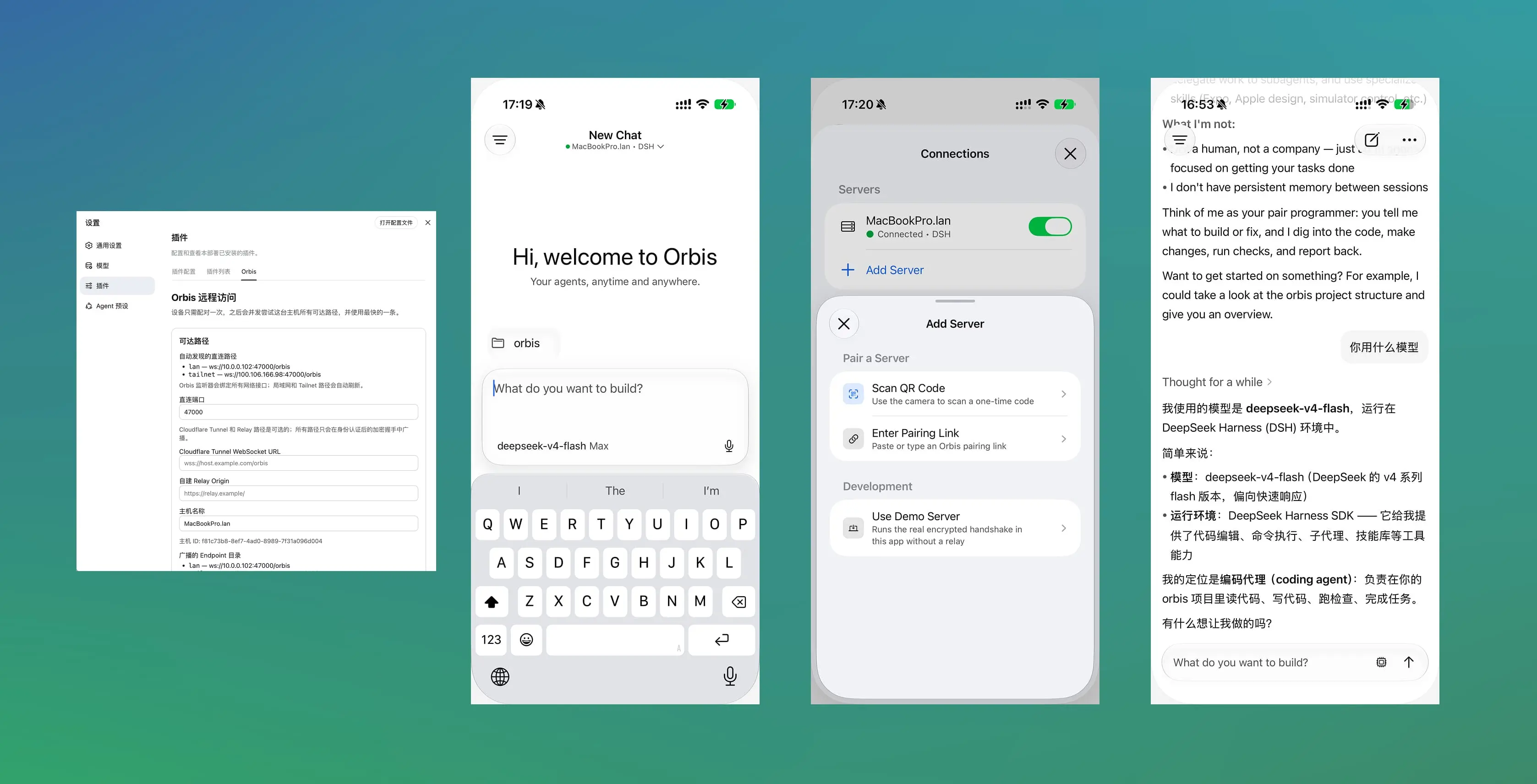
Orbis is a remote control client for Deepseek Harness (DSH).
The Orbis plugin provides device pairing, end-to-end encrypted transport, and real-time updates across multiple devices.
Getting Started
- Download the Orbis app. It is currently in beta. iOS: Join TesFlight. Android: Working in progress.
- Install the Orbis plugin into DSH.
npx @deepseek-ai/dsh plugin --profile web add @orbisapp/remote-dsh@latest
- Configure the plugin and pair your device from the DSH web plugin page (Settings - Plugins - Orbis tab).
Development
Install dependencies at the repository root, then use a single command to build the plugin, install it into your local DSH Web profile, and start the test page:
pnpm install
pnpm run serve:dsh
The page is served at http://127.0.0.1:3080 by default. Pass flags to change the port or
point at a specific test directory:
pnpm run serve:dsh --port 3090
pnpm run serve:dsh --workspace-root /path/to/workspace
pnpm run serve:dsh --help
Testing
pnpm run check:core   # typecheck + tests for everything that builds from this repository alone
pnpm run check:dsh    # typechecks and tests the plugin and client entry points against the public DSH SDK
CI runs check:core on every push and every pull request, and again before a release.
check:dsh uses the public @deepseek-ai/* SDK packages installed by the workspace.
Releasing
Releases are driven by Changesets. Ship every user-visible change with a changeset and commit it alongside the change:
pnpm changeset
Changesets maintains one draft release pull request containing all pending changesets. Keep that pull request open while changes accumulate. When the complete release is ready, review the combined version and changelog, mark the pull request as ready, and merge it to publish the release. Changes that do not affect a published package do not need a changeset.
Write release-level highlights and upgrade notes in .changeset/.release-notes/next.md, using
heading level 3 (###) or lower. The version script prepends that Markdown to the generated package
changelog, so the draft release pull request and final GitHub Release show the same notes before the
Changesets list. The release pull request consumes and clears the file for the next release.
Community
Wechat Group