
dsh-subagent-profile
Agent & WorkflowmuzyLink/dsh-subagent-profile
Dispatch subagents in DSH with per-task model, reasoning effort, and tool scope selection, including cost estimation and safety checks.
- deepseek-harness
- dsh-plugin
- subagent
Verification and compatibility
This section shows evidence collected by the catalog. Undeclared information is labeled as unknown.
- Current-version compatibility
- Verified on the catalog Harness version
- Declared Harness range
- Not declared
- Declared platforms
- Not declared
- Profiles
- web
- Build approval
- No requirement detected
- Permissions
- Not declared
- External services
- Not declared
- Telemetry
- Unknown
This is not a security endorsement. Review source, permissions, and configuration before installing.
View evidence and scope
Verification covers only the named source, version, and Harness environment. It does not guarantee future compatibility.
dsh-subagent-profile@0.4.0- The plugin completed a load check in an isolated environment.
README
dsh-subagent-profile
For DeepSeek Harness (DSH).
Dispatch subagents in DeepSeek Harness: pick model, reasoning effort, and tool scope per task; save common combos as named profiles for reuse. Built-in safety checks, cost estimation with savings analysis, and a full decision ledger.
Why this plugin
Built-in subagent | dsh-subagent-profile | |
|---|---|---|
| Per-subtask model / preset | ❌ same brain for every subtask | ✅ pick per subtask |
| Reusable named setups | ❌ | ✅ profiles |
| Tool-scope narrowing | ❌ | ✅ whitelist ∩ parent, run_code always removed |
| Safety checks | ❌ | ✅ whitelist / cost / intersection / approval / budget, all recorded |
| Cost visibility | ❌ | ✅ per-dispatch estimate + savings comparison |
| Decision ledger | ❌ | ✅ full trace: request vs. effective, gates, execution, settlement |
| GUI management | ❌ | ✅ settings page + per-session ledger tab |
Installation
dsh plugin --profile web add dsh-subagent-profile        # published package
dsh plugin --profile web add ./dsh-subagent-profile      # from a local checkout
Restart dsh web. This is a standard bundle plugin: it provides the dispatch tool, the profile provider, the subagent-profiles service, the /subagent-profiles/* loopback management routes, the settings page (「子 Agent 方案」), the per-session ledger tab, and the dispatch tool-call card in the web GUI. On startup it also self-installs an agent preset — orchestrator (「编排者模式」) — pick it in the new-session preset picker. The sync is idempotent and re-runs on every startup, so upgrading the plugin updates the preset.
Usage
1. Configure sub-agent profiles
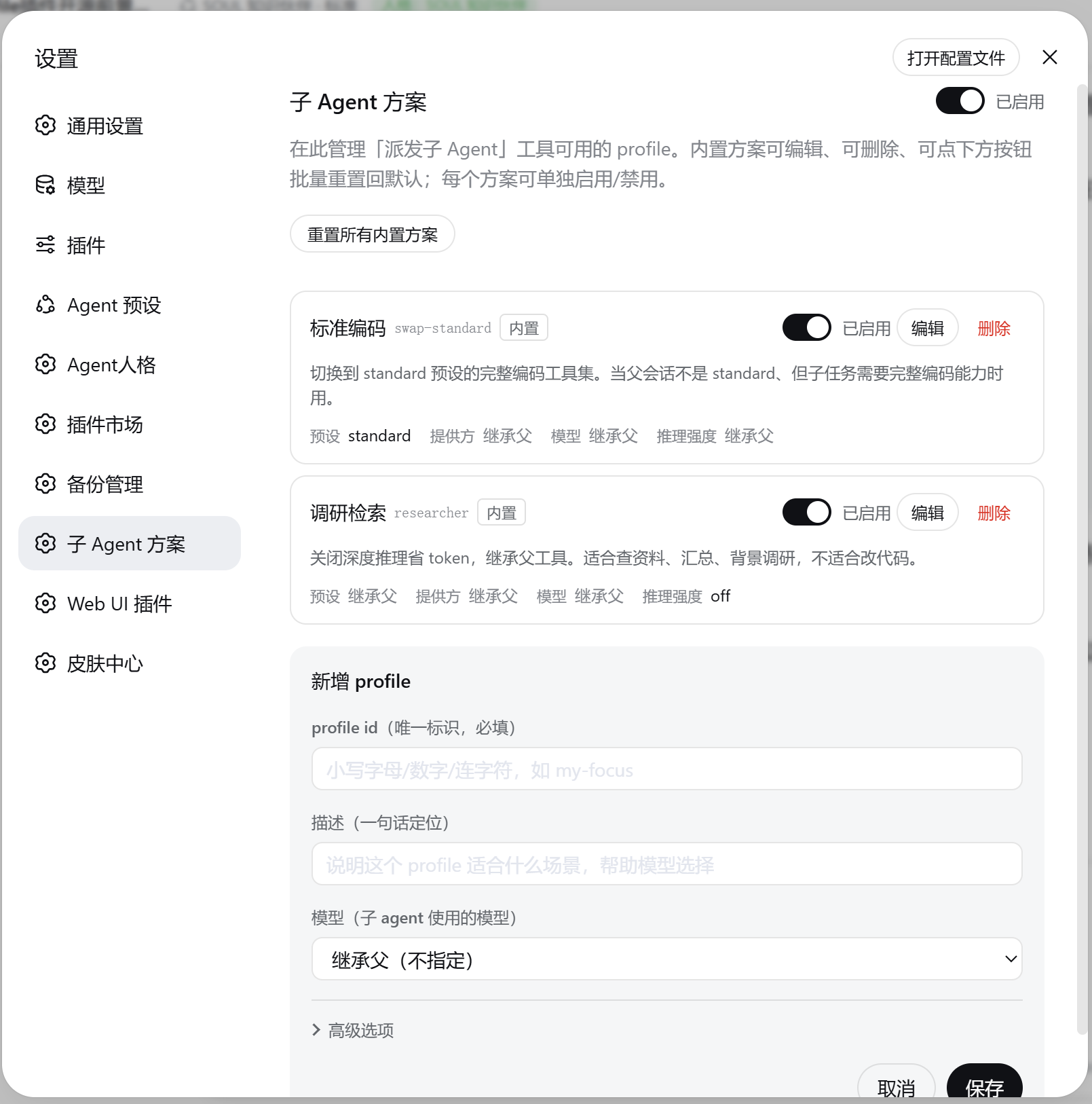
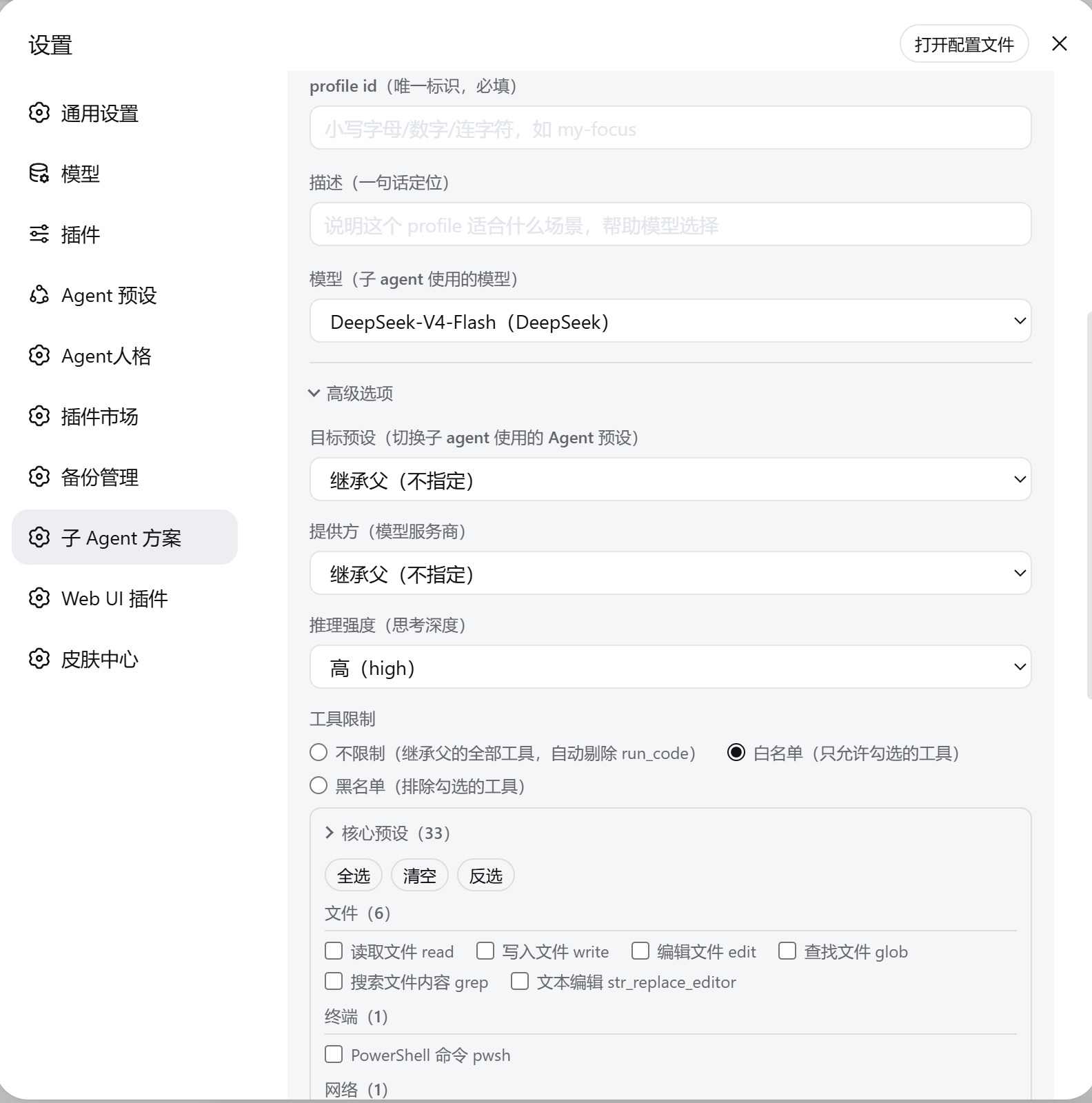
Profiles are managed in the settings page — each one bundles preset + model + reasoning effort + tool scope (and optionally a persona), and can be enabled, disabled, edited, or reset individually. Two built-ins ship:
| Profile | Purpose |
|---|---|
swap-standard | switch the child to the full standard coding toolkit |
researcher | deep reasoning off, search-only tools |
Profiles live in ~/.dsh/subagent-profiles.json and take effect immediately (edits are made from the settings page).
2. Dispatch per subtask — the dispatch tool
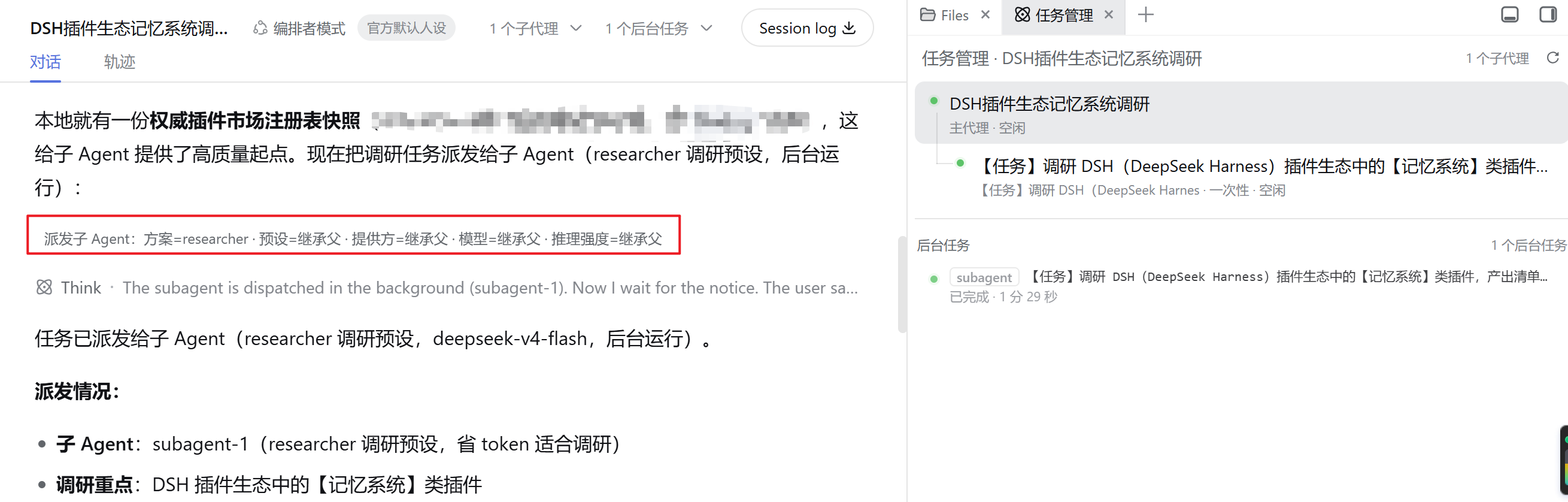
dispatch(
  profile: "researcher",        // preset + model + reasoning effort + tool scope
  prompt: "Survey the DSH plugin ecosystem and compare direct competitors",
  run_in_background: true
)
3. Review in the decision ledger
Every session has a ledger tab that records each dispatch decision: what the parent saw and requested, what actually took effect (with ignored-request highlights), which tools were removed and why, how execution went (including stalls and parent interventions), and what it cost. Safety-check failures are surfaced with fix directions.
Safety model
Delegation never lets a subagent gain more power than you already have — this is the default, with no configuration:
- Tools only shrink. A child's tool set is the intersection of the profile's tools and the parent's tools, and
run_codeis always removed. - Approval is never bypassed. Delegation does not waive the host's approval requirements; operations that need approval are rejected automatically.
- Cost is capped. Model, reasoning effort, tokens, and recursion depth are all bounded; out-of-range values fail loudly instead of silently downgrading.
- An escape hatch, explicitly. Non-official presets can be allowed per-preset (default off, each allowance audited).
Observability & notifications
- Live status. Background dispatches show live phase badges (start / gate / create / running / settled), driven by host job events with polling fallback.
- Reminder center. Urgent events (escape-hatch allowances, audit degradation, budget anomalies) raise a persistent badge; the notification center keeps every reminder with full context — parent session, child session, task summary, and outcome — plus one-click jumps to the related sessions. Normal orchestration events (e.g. a parent not adopting a child's result) are recorded in the audit ledger without interrupting you.
- Dispatch suggestions. Based on historical dispatch statistics, the plugin can inject read-only optimization hints for the parent agent (e.g. "this profile has a low recent success rate, consider switching") — hints only, nothing is changed automatically.
- Subagent header badge. Child sessions show a compact summary badge (e.g.
继承父会话 · 前台— "inherits the parent session, foreground"); hover for the full detail (model / effort / preset / mode / origin).
Data
~/.dsh/subagent-profiles.json— the profile registry (edited from the settings page).~/.dsh/subagent-profiles.state.json— the plugin's enable/disable switch (default enabled).~/.dsh/subagent-profiles.failed-traces.json— the failure ledger (dispatch failure traces).~/.dsh/subagent-evolution/— the decision ledger and statistics:dispatch.jsonl— per-dispatch decision records (no prompt content).summaries.json— aggregated per-profile statistics (versioned, rebuilt on corruption).adopted-state.json— adoption verdict state for child results (cross-restart).reminders.json— reminder store (one reminder = one audit record).
~/.dsh/.agent-presets/orchestrator/— the self-installedorchestratoragent preset (synced from the bundledpresets/orchestrator/on every startup).
DSH_HOME is respected and defaults to ~/.dsh. Uninstalling the plugin removes the data files above and the self-installed orchestrator preset directory (other plugins' presets are left untouched); re-installing or re-launching re-syncs the preset and regenerates the data files.
Known limitations
- Background dispatch requires
@deepseek-ai/dsh-jobsand@deepseek-ai/dsh-tool-jobsto be loaded; otherwise it fails with "dispatch: 后台派发不可用:缺少 jobs 服务". - Continuable mode goes through the DSH standard composition path, so the
presetswap andreasoningEffortare ignored (the child inherits the parent preset at the default reasoning effort). - Who decides the child's final tool set depends on the mode:
- Continuable: narrowed by this plugin up front — the child's
allow= (parent tool set −run_code−deny) ∩allow. Assumption: continuable inherits the parent preset, so the child's tool set ≈ the parent's; if dsh's behavior changes so the two differ (e.g. a future preset swap composing a different tool set), tool narrowing fails with a hard error (conservatively safe — never silently granting more), to be replaced with a true parent ∩ child intersection once dsh provides an official seam. - One-shot: decided by dsh; the plugin cannot read the final restricted result and the card reports "tools are finally granted by the system".
- Continuable: narrowed by this plugin up front — the child's
- Cost figures are estimates: computed from an average per-dispatch price (measured once per model); fine-grained per-token pricing is on the roadmap. The UI labels estimates as such and shows a note when the sample size is small.
Repository structure
dsh-subagent-profile/
├── index.mjs                     # host side: the plugin itself (dispatch tool, profile provider, service, HTTP routes)
├── lib/
│   ├── client.js                 # browser side: settings page + ledger + dispatch tool-call card
│   └── core/                     # host-side modules (lightweight layering)
│       ├── pure.mjs              # dependency-free pure functions (sanitize / prune / guard math — unit-tested)
│       ├── shims.mjs             # the single @deepseek-ai import facade (guards fail loud, helpers degrade softly)
│       ├── catalog.mjs           # tool-name → zh / category tables (zero-dep)
│       ├── catalog-cache.mjs     # process-shared catalog snapshot (models / presets / tools, TTL cache)
│       ├── cost-guard.mjs        # runtime capability checks (provider / model / reasoning effort)
│       ├── cost-evidence.mjs     # counterfactual savings evidence (token-saving proof)
│       ├── prices.mjs            # per-dispatch price table (average-based placeholder)
│       ├── decision-trace.mjs    # decision trace (checks / effective / settled) + failure ledger
│       ├── delegation.mjs        # background one-shot settling + child usage collection
│       ├── dispatch-gates.mjs    # pre-dispatch safety checks (whitelist / cost / intersection / budget)
│       ├── dispatch-guard.mjs    # concurrency + per-parent token budget guard
│       ├── dispatch-schema.mjs   # dispatch tool input/output schema declarations
│       ├── dispatch-tool.mjs     # dispatch tool factory (defineTool + execute + syncTool)
│       ├── draft-gates.mjs       # draft profile gates (three checks)
│       ├── drafts-store.mjs      # draft profile persistence
│       ├── escape.mjs            # escape-hatch allow store
│       ├── evolution-ledger.mjs  # decision ledger (jsonl) + governance audit
│       ├── evolution-summary.mjs # aggregate statistics (per-profile, capability/budget axes)
│       ├── evolution-advice.mjs  # read-only dispatch suggestion generation
│       ├── adoption-tracker.mjs  # child-result adoption verdict tracking (cross-restart)
│       ├── adoption-reminder.mjs # adoption-verdict reminder generation
│       ├── reminder-store.mjs    # reminder store + audit-coupled records
│       ├── background-ledger.mjs # background job ledger (in-memory, resets on restart)
│       ├── http-routes.mjs       # settings loopback HTTP routes
│       ├── intersection.mjs      # tool-intersection pure core
│       ├── presets-sync.mjs      # bundled preset self-install (hash-gated sync)
│       ├── profile-provider.mjs  # the `profile` subagent provider
│       ├── profile-directory.mjs # read-only profile directory (for the model)
│       ├── profiles-store.mjs    # profile registry store + switch persistence
│       └── whitelist.mjs         # system-trust preset whitelist
├── presets/orchestrator/         # bundled "orchestrator" agent preset (self-installed, synced on every startup)
├── cordis.patch.yml              # bundle patch: inserts the plugin row into the host composition
├── .gitea/workflows/ci.yml       # bare-CI (Gitea Actions; needs an Act runner on the server)
├── package.json                  # metadata, files whitelist, exports (test / test:bare / preflight scripts)
├── scripts/
│   ├── preflight.mjs             # preflight: preset-tree reconciliation + no hardcoded version badge (zero-dep)
│   └── leak-scan.mjs             # public-release gate: scans all history + worktree for sensitive patterns
├── docs/
│   └── screenshots/              # README screenshots
├── test/                         # host-side tests (node:test, zero extra deps; 438 cases)
│   ├── README.md / README.zh.md  # test directory guide (EN/ZH) — two-tier split explained
│   ├── harness/ctx.mjs           # fake Cordis ctx + ~/.dsh isolation
│   ├── pure / input-schema / catalog-integrity.test.mjs   # bare tier (import-free, runs in bare CI)
│   └── *.test.mjs                # junction tier (local only): characterization / facade / gating / persist / recycle /
│                                 #   cost-guard / continuable-guard / decision-trace / dispatch-guard / escape-hatch /
│                                 #   evolution-* / csrf / label-preset-sync / percall-spec / trust-label / audit-meta / …
├── README.md / README.zh.md      # this document (EN/ZH)
└── LICENSE
Contributing
Found a bug or have an idea? Open an issue or submit a pull request — all contributions are welcome.
If this plugin has been useful to you, please give it a ⭐ on GitHub — it helps others find it.
Credits
The bundled orchestrator agent preset was inspired by dsh-liangshen (梁神模式) from dsh-web-ui, licensed under Apache-2.0. Thanks to its author for the great work.
License
MIT — Copyright (c) 2026 muzyLink


