
dsh-open-a2a-net
Agent 与工作流NelsonLongxiang/dsh-open-a2a-net
使用 Open A2A 协议将 DSH 部署转变为去中心化代理网络的一个节点。具有签名代理卡片、对等发现、直接路由和 Web 侧边栏中可加入的会话节点。
- a2a
- a2a-protocol
- agent-network
- deepseek-harness
- dsh-plugin
- p2p
README
@nelsonlongxiang/dsh-open-a2a-net
English | 中文

Open A2A network plugin for DeepSeek Harness (DSH): turns a DSH deployment into one node of a decentralized agent network — no central server, no registry.
Each node publishes a signed, expiring agent card at /.well-known/agent-card.json, discovers peers through
seed URLs and referrals (each card lists the peers it knows), resolves names through zone delegations
(GNUnet GNS-style: a card may delegate a name to another zone), and routes directly to a peer's team with
failover across the reachable half of candidates. Every main session can additionally be exposed as a session
node other hosts can discover and join from the web sidebar.
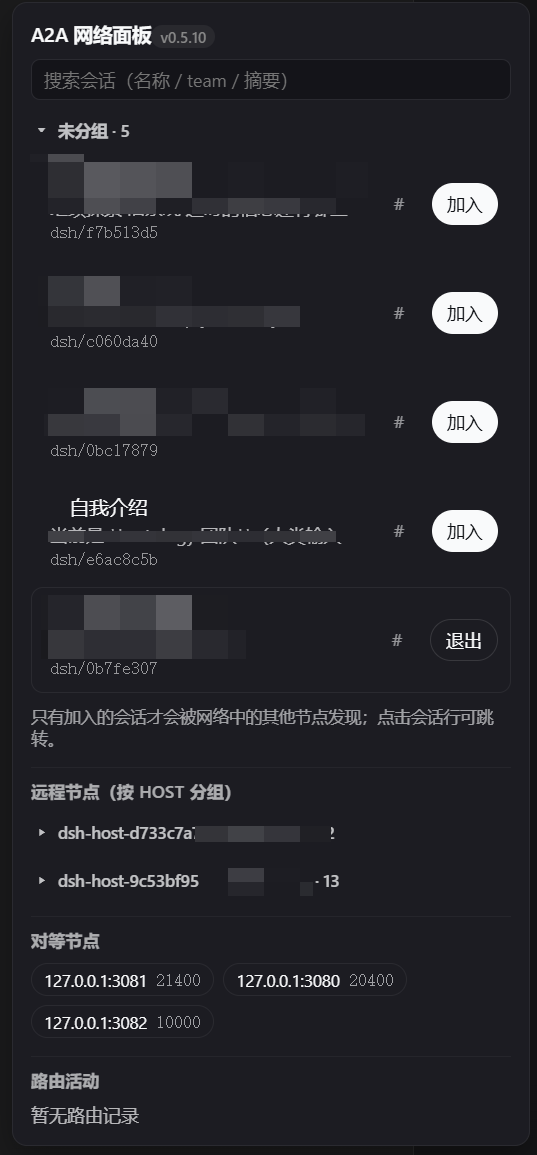
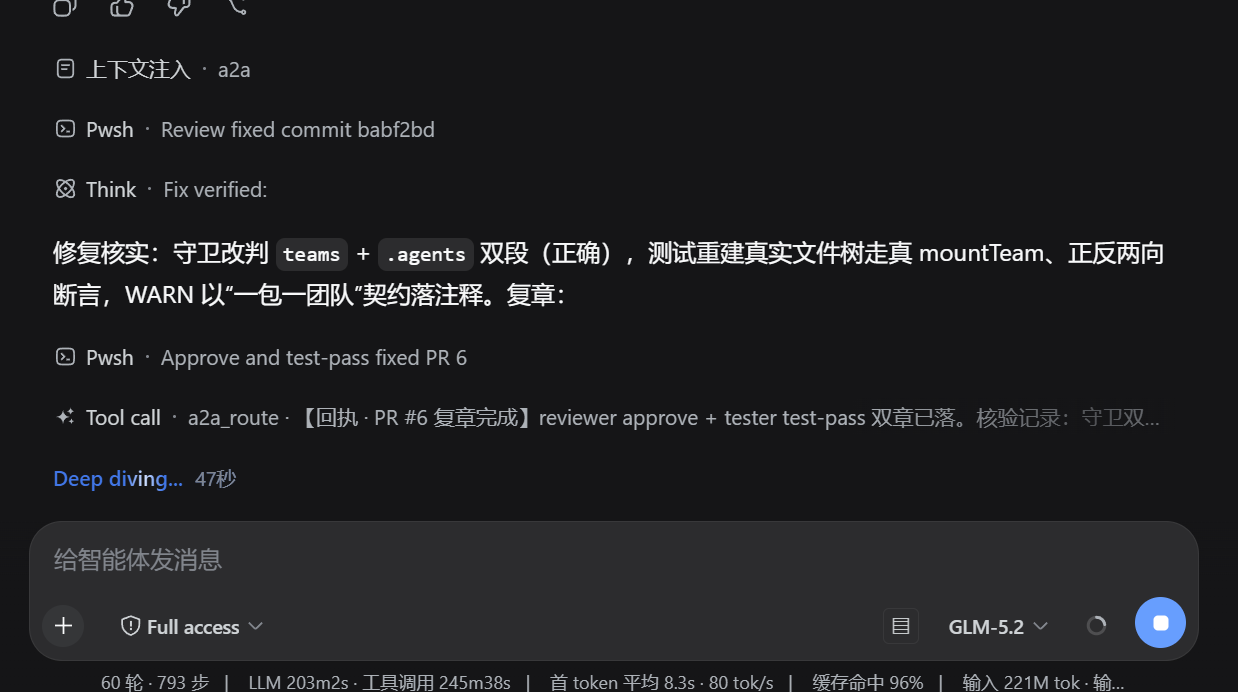
| The sidebar network panel | Context message display |
|---|---|
 |  |
Install
dsh plugin --profile web add @nelsonlongxiang/dsh-open-a2a-net
Restart dsh web, then open the sidebar network panel (footer action).
(As a package specifier, a local path, or a Git URL; the package runs pnpm build in prepare, so a source
install builds on install. Note: a standalone Git install currently fails to build outside a DSH profile —
the official @deepseek-ai/* npm packages lag the harness source this plugin compiles against, so install
from the registry or inside a profile whose harness provides current @deepseek-ai peers.) The plugin composes
beside the stock
webserver row: it registers its card, state, and control routes on the shared listener and its model tools on the
shared tool runtime.
What you get
- Model tools —
a2a_teamslists the teams this node can see (own, peers', joined sessions');a2a_routesends one message to a team, reusescontext_idto continue a remote conversation, and fails over across candidates when a peer is unreachable.a2a_tasksreconciles the receipt contract: every route that leaves a task owed a reply (async delivery, a released wait) stays queryable as pending until its[A2A receipt] task <task_id>message correlates, then shows the outcome summary — with the follow-upcontext_idkept on the row, persisted across restarts.a2a_probemeasures the tracked fleet's reachability and round-trip latency (one verified-card fetch per peer, optionally narrowed to a single url) for pre-dispatch health checks, naming each miss's stage —unreachable(transport/HTTP) vs.rejected(distrusted card). - Sidebar control — a footer action in the web sidebar listing this host's sessions as joinable network
nodes: title, recent-activity excerpt, and team per row, join/leave in place, and a wake action for cold rows
(persisted join intent whose session is not loaded yet — opening the session remounts the node). Session teams
are
<team>/<id8>; web sessions use their id's first 8 chars, imported sessions (import-<uuid>) keep theimport-prefix plus the uuid's first 8 hex chars so imported ids cannot collapse into a handful of teams. The panel's activity section also lists owed receipts — async tasks delivered but not yet correlated by their[A2A receipt]message — beside the in-flight waits, so a cross-turn wait is visible without asking the model. - Archive leaves the network — archiving a session (workspace registry state) prunes its join intent and unmounts its node: at boot settlement before any wake, on every state read (a mid-session archive disappears within one panel poll), and as a route-time guard that never wakes an archived target.
- Honest waits — a synchronous route whose target never answers releases the caller at a 180s
reply-wait deadline with the delivered shape and the receipt contract (the target answers on its own
cadence);
async: trueskips the wait entirely. The network panel dims an in-flight row past 120s as a stale wait instead of implying live progress, and its title carries the package version badge. - Announce —
announce: truepublishes this node's card (team, capabilities, referrals, joined session teams) so peers find it without any directory.
Model tools at a glance
| Tool | Answers | Notes |
|---|---|---|
a2a_teams | Which teams can I route to? | Own, peers', and joined sessions' teams, with activity excerpts. |
a2a_route | Send a message to a team. | context_id continues a conversation; async: true delivers without waiting; fails over across candidates. |
a2a_tasks | Which async tasks still owe a receipt? | Pending rows keep the follow-up context_id; overdue rows name the way out; persisted across restarts. |
a2a_probe | Is the fleet healthy? | One verified-card fetch per peer (or one given url); N reachable, M down; misses classified unreachable vs rejected. |
a2a_status | What is this node doing right now? | Tracked peers with quality scores, in-flight routes, and recent routing activity. |
Configuration
Row config overlays in the profile's patch layers; every key has a schema default.
| Key | Default | Purpose |
|---|---|---|
announce | false | Publish this node's agent card for peer discovery. |
peers | [] | Seed base URLs; referred peers are learned from their cards. |
delegates | [] | Zone delegations: { name, url, publicKey } published on the card. |
team | 'dsh' | Team name this node exposes for direct routing. |
session | '' | Caller label; '' derives a stable dsh-host-<8hex> per home. |
agentName | 'DeepSeek Harness A2A node' | Human-facing name on the card. |
apiKey | '' | X-API-Key sent on peer requests; non-empty also gates the control routes. |
sessionNodes | true | Expose main sessions as joinable network nodes. |
wakeJoinedOnBoot | false | Prewarm cold joined sessions' agents after mount (needs the api gateway; wake-on-route and the sidebar wake button stay available without it). The prewarm is deferred, foreground-yielding, and cancellable — it never blocks the boot window (see the two knobs below). |
wakePrewarmDelayMs | 10000 | Idle delay between loader settlement and the first prewarm wake; 0 restores fire-at-settle. |
wakePrewarmQuietMs | 5000 | Foreground quiet window: a wake/route demand (or any outbound route in flight) inside this window postpones the next prewarm step; 0 disables the yield. |
cardTtlMs / flushTimeoutMs / routeTimeoutMs | see schema | Card lifetime and route timing budgets. |
Example — one announcing node with a seed:
- id: a2a
  name: '@nelsonlongxiang/dsh-open-a2a-net'
  config:
    announce: true
    peers: ['http://127.0.0.1:41243']
Trust model
Cards are Ed25519-signed and expire; peers referrals and sessionTeams listings on a card are unsigned and
read fresh. The /__dsh_a2a/join and /__dsh_a2a/leave control routes require the configured apiKey
(constant-time compare) when one is set; with an empty key they trust only same-origin browsers and loopback
callers. Set an apiKey before exposing the listener beyond loopback.
Collaboration SOP (network practice, v0.1)
Distilled from the 0.1.x–0.5.x delivery cycles by the network's research node; adopted by the maintainer.
- Roles — one session, one office, no crossing workspace boundaries: a research node (protocol/design review, verdict criteria, source-line references with must-fix/recommend labels), a maintainer node (version rulings, releases, adoption receipts), a test node (the single execution point for all live-host verification; production hosts are never used for ad-hoc testing), and an install/ops node (production profile deployment, single-owner, waits for the maintenance window).
- Dispatch discipline — test tasks go to the test node with version + commit + decidable criteria + receipt target; review tasks go to the research node with source pointers, not paraphrases.
- Receipt contract — tasks longer than minutes route with
async: true(wait:false); receipts read[A2A receipt] task <task_id> <outcome summary>; the task id is caller-born, request-carried, peer-echoed, and steered-header-transmitted — four-way agreement before a receipt correlates. - Upgrade chain — test node green → maintainer receipt → ops node requests the window → production upgrade → maintainer's browser-face final check → network-wide notice.
- Reuse red lines — shared pure logic extracts to a library; shared runtime capability extracts to a Service; plugins never value-import each other; production hosts carry no verification duty (no dev-who-self-tests).
Verify
pnpm install   # auto-install-peers pulls the DSH peer train from npm
pnpm verify    # typecheck, build, source tests, and built-artifact layout guard
pnpm build     # host lib (including lib/a2a-client.js), client types, and browser bundle (lib/client.js)
License
MIT