
dsh-research-report
模型与数据PerryLink/dsh-research-report
DeepSeek Harness 可验证研究报告引擎,将声明绑定到不可变证据快照,进行字节级验证,并封装带可重算清单哈希的版本化报告。
- audit
- citation-verification
- cordis
- deepseek-harness
- dsh
- dsh-plugin
- evidence-ledger
- research
- verifiable-report
验证与兼容性
这里展示目录实际采集到的证据;未声明的信息会明确标为未知。
- 当前版本兼容性
- 已在当前目录版本验证
- 声明的 Harness 范围
- 未声明
- 声明的平台
- 未声明
- 适用 Profile
- demo
- 构建授权
- 未知
- 权限声明
- 未声明
- 外部服务
- 未声明
- 遥测声明
- 未知
这不是安全背书;安装前仍应查看源码、权限和配置。
查看证据与判定范围
验证仅覆盖标出的来源、版本和 Harness 环境,不代表未来版本仍然兼容。
dsh-research-report@0.3.0- 插件通过清单与静态结构检查,尚未完成运行时加载检查。
README
📑 dsh-research-report
- 1024 store channel:
npm i -g dsh1024once, thendsh1024 plugin --profile web add dsh-research-report(counts toward the deepseek1024.com install ranking).

A verifiable research-report engine for DeepSeek Harness.
Every claim is bound to immutable evidence snapshots, verified byte-for-byte, and sealed into a versioned report whose manifest hash anyone can recompute.









English · 简体中文 · Español · Português · हिन्दी
📖 Ecosystem knowledge base — measured data, not marketing: plugin development guide · plugin-selection data · maintenance criteria.
⭐ 如果它帮到了你
这个插件是 DSH 插件家族的一员(40+ 个,全部 Apache-2.0)。如果你在用,给个 star —— 它不会解锁任何功能,但会让下一个人在搜索里更容易找到它。
English: part of a 40+ plugin family for DeepSeek Harness. If it is useful, a star helps the next person find it — nothing is gated behind it.
What is dsh-research-report?
A verifiable research-report engine for DeepSeek Harness.
Every claim is bound to immutable evidence snapshots, verified byte-for-byte, and sealed into a versioned report whose manifest hash anyone can recompute.
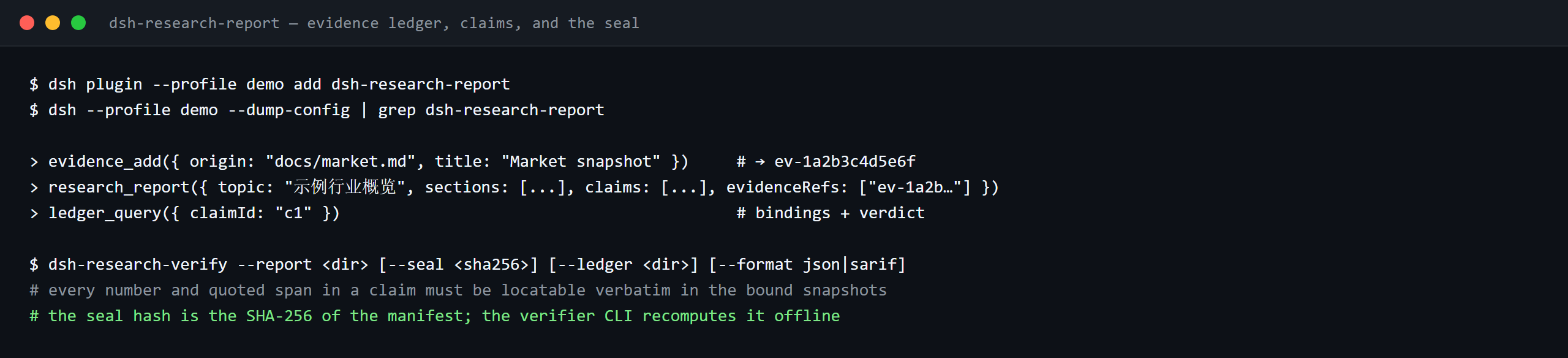

The same run, animated.
Compatibility
- DeepSeek Harness
dsh-v0.2.1-alpha.1(verified 2026-09-25). npm dev/test line0.1.7-rc.2; peers>=0.1.6-0 <0.2.0 || >=0.1.7-0 <0.2.0. The compat matrix pins all four declared peer lines. On this lineSession.append's third parameter is aSurfaceIntentfor surface-eligible types only, soresearch-report/*events still do not land in the session log: the ledger journals are the durable source of truth and the audit mirror activates only once a host knows the vocabulary (the regression lock intest/events-gate.spec.tspins that). 0.1.5-alpha.1 (adapted 2026-09-09): the session envelope keeps its ignorable field for stored-log read compatibility only - Session.append still cannot stamp it, so audit-gate behavior is unchanged. Verified 2026-09-11 against the published 0.1.5-rc.2 types (full local gate chain); the compat workflow pins both declared peer lines. - Node
^22.19.0 || >=24.0.0, ESM only ("type": "module"). - Peer dependencies:
@deepseek-ai/cordis ^4.0.2,@deepseek-ai/schemastery ^3.18.2, and@deepseek-ai/dsh-session,@deepseek-ai/dsh-tools,@deepseek-ai/dsh-system-prompt,@deepseek-ai/dsh-web,@deepseek-ai/dsh-jobsat>=0.1.6-0 <0.2.0 || >=0.1.7-0 <0.2.0. - Optional siblings (never required):
ctx.webproviders for URL capture/gather,ctx.jobsfor background assembly,ctx.dataQuality(dsh-data-quality) for dataset citation cross-checks.
What you get
- Evidence ledger — a content-addressed snapshot store (
<ledgerRoot>/objects/<sha256>+ JSONL journals). The same content is stored exactly once; snapshots are immutable; every read recomputes the hash, so tampering or deletion is detected instead of trusted. - Claim ↔ evidence binding — claims register with the evidence ids they rely on; the ledger keeps the binding and every verification verdict (latest wins).
- Byte-level verification — every number and quoted span in a claim must be locatable verbatim in the bound snapshots. No bound evidence, or no checkable literal, marks the claim
unverified; bound evidence that cannot confirm or deny the claimed literals marks itinsufficient; a label whose snapshot value differs (the claimed value absent) marks itdisproven; tampered/missing snapshots mark itcontradicted. No semantics, no embeddings — auditable byte checks. - Optional numeric bridge — when a claim cites a structured workspace dataset (CSV/JSON) and
dsh-data-qualityis mounted, citations are cross-checked with tolerances through its frozenverifyCitationscontract; a dataset mismatch disproves the claim. - DOI evidence (zero network) — DOI origins are validated deterministically (
10.xxxx/xxxxstructure, a prefix whitelist, and a DOI character set); invalid DOIs fail loud. Optional journal/year metadata is accepted, andrequireJournalMetadatagates academic DOI evidence only when enabled. - Versioned sealed reports —
<reportRoot>/<slug(topic)>/<YYYYMMDD-HHmmss>/report.md+manifest.json+verification.jsonl+disconfirmation.jsonl; the seal hash is the SHA-256 of the manifest, which itself carries the report hash, every evidence hash, and the hash of each audit journal. - Pre-delivery re-audit & seal interception — before sealing, every bound claim is re-verified offline and journaled to
verification.jsonl; verdict drift, tampered/missing bound evidence, or a journal serialization failure blocks the seal (fail loud, no tunable). - Falsification ledger — every contradicted or disproven claim is recorded in
disconfirmation.jsonl(claim + evidence references + reason) and listed in the report'sfalsification logappendix. - Negative knowledge — a disproven claim is remembered by its content hash (
disproofs.jsonl); the same text re-reported against unchanged evidence is forced back todisprovenand only re-verifies once the evidence changes. - Read-only verifier loop — after sealing, a deterministic
verifySealedReportfallback (zero network, zero model) recomputes the seal and audit hashes and re-checks every claim, writing the machine check toverifier-note.md; whenctx.jobsis mounted a read-only verifier job is also spawned (the model review is an enhancement, never a replacement). - Standalone verifier CLI —
dsh-research-verify --report <dir> [--seal <sha256>] [--ledger <dir>] [--format json|sarif]recomputes the seal hash + per-claim re-checks from the sealed directory alone and prints a JSON envelope or a SARIF 2.1.0 document (see Verifier CLI). - Session-anchored evidence —
evidence_addaccepts an optionalsessionRef(sessionId+eventRange, validated loud); the anchor is stored, rendered in Appendix B, and registered in the manifest andverification.jsonl. Session-anchored evidence verifies honestly asunverified(session-anchored evidence requires a manual check against the session log). - Honest gaps — unverified, insufficient, contradicted, and disproven claims keep a visible
[未核实]/[证据不足]/[与证据矛盾]/[已证伪]marker in the report body and are listed in Appendix A. Nothing is silently passed. - No deep-research loop — retrieval orchestration is deliberately reused:
ctx.webfor search/fetch,ctx.jobsfor long runs. Planning and synthesis stay with the model (or an upstream plugin).
Quick start
dsh plugin --profile web add github:PerryLink/dsh-research-report
git channel
# From a scratch profile (pins the commit; runs the self-contained `prepare` build)
dsh plugin --profile demo add "github:YOUR_ORG/dsh-research-report#<sha>"
# The profile's pnpm-workspace.yaml gains an allowBuilds entry for dsh-research-report on first add.
npm channel
dsh plugin --profile demo add dsh-research-report
Both channels install the bundle row (see cordis.patch.yml) into the profile's dsh.profile.bundles stack and take effect on restart.
Then, in a session:
evidence_add({ origin: "docs/market.md", title: "Market snapshot" })     # → ev-1a2b3c4d5e6f
research_report({ topic: "示例行业概览", sections: [...], claims: [...], evidenceRefs: ["ev-1a2b…"] })
ledger_query({ claimId: "c1" })                                          # bindings + verdict
Install & uninstall
dsh plugin --profile demo add dsh-research-report       # install
dsh plugin --profile demo remove dsh-research-report    # uninstall
Verify the row mounts: dsh --profile demo --dump-config | grep dsh-research-report.
Configuration
All tunables are Schemastery Config fields; invalid values fail the profile load loudly. Relative roots resolve against the harness working directory (the workspace).
| Key | Default | Description |
|---|---|---|
enabled | true | Master switch; false mounts nothing. |
ledgerRoot | .research-ledger | Evidence-ledger directory (objects + JSONL journals). |
reportRoot | research-reports | Sealed-report root (versioned per topic and timestamp). |
maxEvidenceBytes | 2097152 | Hard cap on one evidence snapshot's UTF-8 bytes. |
maxEvidencePerReport | 200 | Hard cap on evidence items bound into one report. |
fetchTimeoutMs | 20000 | Deadline (ms) for one ctx.web fetch during capture. |
requireJournalMetadata | false | When true, DOI-typed evidence must carry a journal name and publication year at registration (fails loud otherwise). |
Tools & surfaces
evidence_add({ origin, content?, title? })— register one evidence snapshot. Withcontentthe text is stored verbatim; without it a URL origin is fetched throughctx.weband a workspace-relative path is read from disk (reads never escape the workspace). Returns the evidence id and SHA-256 hash.research_report({ topic, title?, sections, claims, evidenceRefs, gather?, depth?, background? })— assemble and seal a report: validate (unregistered claim references are rejected loudly), verify every claim, renderreport.mdwith visible markers, writemanifest.json, and return the seal hash.gather: trueruns ONE search round overctx.weband returns captured candidate evidence plus an explicit gap list — it never auto-assembles.background: truereturns{ kind: 'background', jobId }overctx.jobs.ledger_query({ claimId? | evidenceId? })— read-only binding/verdict queries; evidence is re-hashed on read so a tampered or missing snapshot is reported explicitly. With no id, returns a ledger summary.ctx.researchReport.assemble(request)— the frozen service surface for sibling plugins (seesrc/service.ts; gated byte-for-byte byscripts/verify-frozen-contract.mjs).
Permissions & data
dsh-research-report consumes only public seams: ctx.tools, ctx.systemPrompt, and optionally ctx.web / ctx.jobs / ctx.dataQuality (looked up at call time, never injected). It writes only inside the configured ledger and report roots (both default to workspace-local directories), reads workspace files only inside the workspace, and reaches the network exclusively through the harness web seam — never a direct fetch. Evidence snapshots are immutable and content-addressed; claim registrations are immutable; verdicts are append-only.
Security boundaries
- Tamper-evidence by construction — every snapshot read recomputes SHA-256 against the index; a mismatch verifies the bound claims
contradictedandledger_queryreportsintegrity: tampered/missing. - Workspace confinement — local evidence reads resolve against the workspace root and refuse escapes (both sides are
path.resolved before comparison). - Fail-loud configuration — invalid bounds throw at mount; unregistered claim references, unknown evidence ids, and id/content conflicts throw at assemble.
- No credential handling, no hidden network — URL capture rides
ctx.web(provider selection, error taxonomy, and any SSRF policy stay with the deployment's web providers). - Reversible registrations — every contribution goes through
ctx.effect()/register(), so uninstall and hot reload are clean.
Known limitations
- Byte-level, not semantic — the built-in check locates number/quote literals verbatim; paraphrased claims without a checkable literal verify as
unverified, and a true claim whose number is absent while its label appears with a different value readscontradicted. This is a deliberate v1 choice (auditable beats clever). - Session events are adaptive — the plugin declares typed
research-report/evidence,research-report/verify, andresearch-report/sealsession events, but the 0.1.5-alpha.1Session.appendstill exposes noignorableoption and no plugin event-registration surface, so appends activate only when the host build knows the types (otherwise the persistence layer would refuse the log on restore). The ledger journals are always the durable source of truth. - Default profiles mount no fetch provider — the shipped
dsh-basemounts search only, so URL capture fails loud (WEB_UNAVAILABLE/WEB_PROVIDER_UNAVAILABLE) until a fetch provider is configured; search-basedgatherlists uncaptured sources in the gap list. - Single-workspace scope — ledger and report roots resolve against the harness working directory at mount; multi-workspace deployments should configure absolute roots per profile.
Verifier CLI
The standalone dsh-research-verify binary (bundled as lib/cli.js, zero @deepseek-ai imports) audits any sealed report directory without mounting the plugin:
dsh-research-verify --report <dir> [--seal <sha256>] [--ledger <dir>] [--format json|sarif]
--report <dir>— the sealed report directory (manifest.json+report.md+ the audit journals).--seal <sha256>— the expected seal hash to compare the recomputed manifest hash against. Omitted = the recomputed hash is reported without comparison.--ledger <dir>— the evidence ledger root (objects/<sha256>+index.jsonl) enabling per-claim byte-level re-checks. Omitted = claim re-checks are skipped honestly.--format—json(default) orsarif(SARIF 2.1.0).
It recomputes the seal hash (SHA-256 of manifest.json), the report.md hash, and the audit-journal hashes, re-runs the byte-level + integrity check for every claim, and exits non-zero when any performed check fails. The same verifySealedReport / buildVerificationReport / renderSarif / renderVerificationJson functions are exported from the package for library use.
Development
pnpm install
pnpm run typecheck && pnpm run typecheck:ci
pnpm test
pnpm run build
pnpm run verify:self-contained && pnpm run verify:artifacts
node scripts/check-readme-sync.mjs
node scripts/verify-frozen-contract.mjs
pnpm pack
typecheckresolves@deepseek-ai/*through the installed 0.1.7-rc.2 peers;typecheck:ciclearsskipLibCheckand enablesverbatimModuleSyntaxagainst the published types. Both must stay green.- Tests use the real
Context/Session/ToolRuntime/LocalJobRegistry/WebRuntimefrom the 0.1.7-rc.2 peers; only network backends are scripted providers registered through the realctx.webregistries. - Release:
node scripts/release.mjs <x.y.z>(bumps, stamps CHANGELOG, re-runs the gate, commits + tags; never pushes).
Topics
dsh, dsh-plugin, deepseek-harness, cordis, research, evidence-ledger, verifiable-report, audit, citation-verification
Contributors
- PerryLink — original author and maintainer: plugin architecture, evidence ledger, byte-level verification, sealed reports, five-language documentation, CI and release automation.
PerryLink DSH Plugin Family
This project is one of the 33 actively maintained DeepSeek Harness plugins from PerryLink — the roster is 42, of which 6 are frozen and 3 retired; every one keeps its row below, with the reason in the Status column. If this one helps you, the others likely will too:
| Plugin | One-liner | Status |
|---|---|---|
| dsh-auto-review | Second-model auto-review on the approval chain, fail-closed by default | |
| dsh-autotier | Automatic strong/cheap model-tier routing with deterministic risk guards and a /tier command | |
| dsh-background-agents | Durable background child agents with a Web UI sidebar, messaging and interrupt | 🚫 RETIRED — see the note above |
| dsh-budget | Cost governance for DeepSeek Harness: budgets, carbon, and latency in one panel. | 🧊 FROZEN — see the repo README |
| dsh-catalog | DSH Desktop Market standard catalog source for the PerryLink family | |
| dsh-cert-mcp | Read-only MCP server exposing the certification registry: grades, snapshots and five-dimension evidence | |
| dsh-checkpoint-rewind | Claude Code /rewind-equivalent: snapshots, session forks, one-shot restore | |
| dsh-claude-move | Migrate Claude Code sessions, memory, skills and CLAUDE.md into DSH | 🧊 FROZEN — see the repo README |
| dsh-click | Cross-platform native desktop control for DeepSeek Harness — Windows first. | |
| dsh-composer-history | Terminal-style input history for the web composer: arrows, Ctrl+R search | |
| dsh-data-quality | Dataset quality checks and citation cross-checks (the optional numeric bridge consumed here) | |
| dsh-defend | Prompt-injection, jailbreak, and secret-leak defense for DeepSeek Harness. | 🧊 FROZEN — see the repo README |
| dsh-doublecheck | Engineering-discipline guard: requirements grill, test gates, adversary review | |
| dsh-draw | Unified static-image generation routing for DeepSeek Harness. | 🧊 FROZEN — see the repo README |
| dsh-fast | Read-only performance diagnostics for DeepSeek Harness. | |
| dsh-fund-research | Deterministic research reports for Chinese public mutual funds | |
| dsh-github | GitHub PR/issues integration for DSH, every write gated by approval | |
| dsh-industry-research | Industry research orchestration that seals its deliverables through this plugin's ctx.researchReport.assemble | |
| dsh-laya | Laya typed decisions (noul/choice/score) as a first-class Cordis service and model-visible tools | |
| dsh-library | Local document knowledge base for DeepSeek Harness. | |
| dsh-local-ai | Local-model (Ollama) integration for DeepSeek Harness. | |
| dsh-lsp-actions | LSP diagnostics, formatting, completion, code actions and rename over language servers | |
| dsh-mask | PII masking middleware: anonymize at the model boundary, restore at the display layer | |
| dsh-mcp-panel | Read-only MCP runtime panel: /mcp command + Settings tab with status, tools and errors | |
| dsh-memento | Approval-gated cross-session memory: ctx.memory seam + SQLite + memory tool | 🧊 FROZEN — see the repo README |
| dsh-observe | OpenTelemetry and Langfuse observability exporter for DeepSeek Harness. | |
| dsh-output-styles | Claude Code outputStyles-equivalent runtime style switching | |
| dsh-permission-rules | Claude Code-style declarative allow/deny/ask permission rules with audit | |
| dsh-plugin-certification | Community certification registry with repro-checkable grades and badges | |
| dsh-plugin-doctor | Zero-dependency static + sandbox smoke detector for DSH plugins | |
| dsh-plugin-guide | Plugin-development knowledge base as an on-demand agent skill | |
| dsh-plugin-kit | Shared zero-runtime-dependency toolkit for the PerryLink DSH plugins | |
| dsh-plugin-upgrade | One-package, one-corridor-index plugin upgrade skill: routes a repository to the matching closed corridor card | |
| dsh-plugin-upgrade-015 | Merged 0.1.3-alpha.1 → 0.1.5-rc.1 upgrade corridor card plus a zero-dependency seam scanner | 🚫 RETIRED — corridors carried by dsh-plugin-upgrade |
| dsh-reach | Multi-channel approval/question bridge: WeChat/Telegram/Feishu, session console | 🧊 FROZEN — see the repo README |
| dsh-research-report | Verifiable research-report engine: content-addressed evidence ledger and sealed versions | |
| dsh-score | Multi-dimensional quality scoring for DeepSeek Harness plugins. | |
| dsh-session-pin | Pin sessions in the Web sidebar with durable ordering | 🚫 RETIRED — see the note above |
| dsh-session-sync | Cross-device session sync for DeepSeek Harness — a dedicated git mirror of your session store. | |
| dsh-skill-pack-security | Security-audit skill pack: secret scan, dependency and supply-chain review | |
| dsh-talk | Voice-first session loop for DeepSeek Harness: talk to it, hear it answer. | |
| dsh-team-rooms | Cross-session team rooms: shared message bus, task board and timeline | 🚫 RETIRED — see the note above |
| dsh-test-drive | Isolated install-and-smoke test drives for DeepSeek Harness plugins. | |
| dsh-ticktick | TickTick/Dida365 task bridge: session-header panel + 11 tools | |
| dsh-translate | Vendor parameter translation and deterministic JSON repair for DeepSeek Harness. |
Install from the DSH Desktop Market
All PerryLink plugins are browsable in the built-in DSH Desktop Market: Market → Sources → add source → paste https://perrylink-dsh-catalog.perrylink.workers.dev/catalog-source.json → select it. Installation still goes through the Market's npm-identity verification and your confirmation.
License
Apache-2.0 — see LICENSE.


